Views: 0 Author: Site Editor Publish Time: 2026-11-17 Origin: Site
Picture this exact setup. You just upgraded your main distribution board. Or perhaps you imported a high-end, heavy-duty appliance rated strictly for 220V. You check your local power grid, and it consistently pushes 230V. The immediate concern hits you. You want to safeguard this expensive equipment against unpredictable power surges, but you hesitate. Will a standard protection relay constantly trip under these conditions? Worse yet, will that slight voltage mismatch slowly roast your equipment's internal components?
I see this confusion daily in the field. It stems from the nuanced differences between nominal voltage ratings—specifically the 220V, 230V, and 240V standards. Property owners fear that installing a 220V-rated device on a 230V line means endless nuisance tripping. They worry about losing power to critical systems like commercial refrigeration or security networks in the middle of the night.
Fortunately, practical electrical engineering offers peace of mind. In almost all scenarios, a 220V protector runs perfectly on a 230V supply thanks to strict manufacturing tolerances. However, relying on outdated fixed-limit hardware is no longer the industry best practice. Upgrades to adjustable digital units or smart IoT-enabled devices are now the standard for future-proofing your electrical safety. Let us break down the mechanics of voltage tolerances, highlight real grid risks, and look at the exact parameters you need to optimize your panel.
High Compatibility: A standard protection relay rated for 220V operates seamlessly on a 230V supply. Global electrical grids adhere to a strict plus or minus 10 percent voltage tolerance. This means a 230V line safely fluctuates anywhere between 207V and 253V.
Nominal vs. Actual Voltage: The distinction between 220V and 230V is largely nominal today. It is a byproduct of international harmonization efforts designed to standardize appliance manufacturing across different continents.
Adjustability is Essential: When dealing with a 230V supply, utilizing an adjustable digital protector allows you to manually define the exact high and low cutoff thresholds. This precise calibration eliminates the frustration of nuisance tripping.
Smart Upgrades: Modern WiFi-enabled protectors offer real-time data monitoring and remote operational control. They stand as the ultimate safeguard for contemporary residential and commercial infrastructure.
Protector vs. Stabilizer: A protector functions as an emergency shield that severs power entirely during critical spikes. In contrast, a voltage stabilizer acts as an active filter that continuously corrects minor deviations without interrupting the circuit.
To grasp why a 220V device operates safely on a 230V network, we must look at the historical evolution of global electrical grids. Decades ago, different regions adopted varying standards based on early infrastructure developments. Much of continental Europe operated on 220V. Meanwhile, the United Kingdom and parts of Australia utilized 240V. This fragmentation created massive logistical headaches for manufacturers who had to design distinct internal components for neighboring markets.
To resolve this friction, regulatory bodies like the International Electrotechnical Commission introduced harmonization standards. The goal was to unify these disparate grids into a single nominal voltage of 230V. Consequently, the terms 220V, 230V, and 240V are now frequently used interchangeably in consumer electronics. Manufacturers specifically engineer their equipment to span this entire spectrum. A product labeled as 220V inherently possesses the internal resilience to handle the harmonized 230V standard without experiencing thermal stress or dielectric breakdown.
Beyond historical standards, we must acknowledge a massive shift currently happening in the electrical sector. As utility companies integrate more renewable energy sources like solar and wind into aging infrastructures, localized grid volatility is spiking. The power supply is no longer a steady, predictable stream. Solar feed-ins during peak daylight hours often push local neighborhood voltages well above 240V. This macro-trend is forcing facility managers and homeowners to migrate away from passive, traditional breakers toward active, data-driven monitoring systems.
In practical application, grids never deliver a perfectly flat, unwavering voltage. Power generation and distribution are subject to constant load changes. As a result, utility companies are legally permitted to supply power within a specific tolerance range. This is universally accepted as a 10 percent deviation from the nominal voltage.
Let us break down the math. Ten percent of a 230V supply is 23V. Therefore, a local 230V grid operates within strict legal and safety compliance as long as the delivered voltage remains anywhere between 207V and 253V. Similarly, a 220V appliance is built to handle up to 242V as a baseline, often pushed to 250V by safety design margins. Because the upper limits overlap so generously, operating a 220V-rated device on a 230V line remains inherently safe.
Before addressing compatibility, it is crucial to understand the internal mechanics of these safety devices. A standard voltage protector is fundamentally a microprocessor-controlled, relay-based shield. Its primary function is to continuously monitor the incoming alternating current sine wave. When internal sensors detect that the voltage has breached a predefined upper limit or dropped below a minimum threshold, the microprocessor instantly triggers a magnetic latching relay.
Specifically, high-quality units execute this physical disconnection in less than 0.1 seconds. This isolates the downstream load from the power supply in mere milliseconds, shielding delicate appliances from destructive electrical anomalies. Once the grid stabilizes and returns to a safe operating window, the device automatically closes the circuit. It restores power without requiring human intervention.
The most common apprehension among property owners is the fear of nuisance tripping. Will the protector constantly shut off the power because the grid is supplying 230V instead of 220V? Fortunately, this is a misconception based on a misunderstanding of factory calibrations.
A standard, non-adjustable 220V protector does not trip the moment the voltage hits 221V. Instead, manufacturers pre-set the overvoltage cutoff point well above the nominal rating to account for the standard tolerance. Most fixed 220V units feature a tripping threshold programmed between 250V and 265V. Since a healthy 230V grid rarely exceeds 245V under normal daily loads, the protector remains entirely passive. It will only intervene when a genuine, dangerous surge pushes the voltage into the 250V danger zone.
While baseline compatibility is generally high, relying on older, cheaper, or rigidly fixed-threshold protectors introduces specific operational risks. The primary danger arises when a low-cost unit is manufactured with an unusually tight overvoltage threshold. For instance, if a basic 220V protector features a hard factory cutoff at exactly 235V, it becomes fundamentally incompatible with a 230V grid.
During low-demand periods—such as late at night when neighboring factories and households power down—the local grid voltage naturally swells. If your 230V supply briefly fluctuates to 238V, that rigidly set 235V protector will trip. This constant cycling cuts power to essential appliances. It causes severe disruption and renders the protective device more of an operational liability than a reliable safeguard.
Conversely, a fixed protector might have an overvoltage threshold set far too high for sensitive electronics. If a device is factory-set to trip at 270V, it will fail to protect 220V-rated appliances from sustained moderate overvoltages. Imagine a scenario where a 230V grid experiences a sustained swell at 260V due to a neutral wire fault at the local substation.
The protector allows this 260V current to pass through freely. Over time, exposing 220V-rated switch-mode power supplies or compressor motors to 260V causes excessive heat generation. This thermal stress degrades internal insulation, dries out electrolytic capacitors, and ultimately leads to premature, catastrophic equipment burnout.
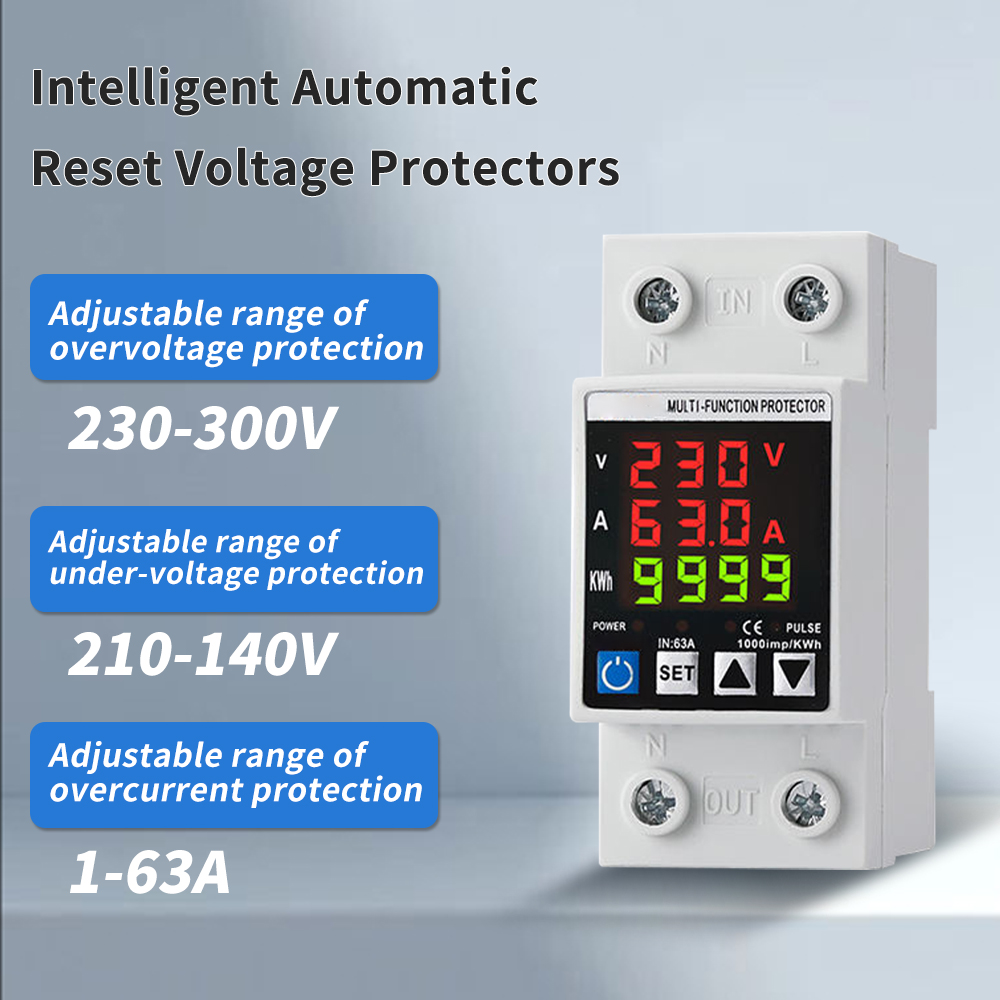
To mitigate the risks associated with arbitrary factory presets, the most effective engineering solution is to abandon fixed-limit hardware entirely. By integrating an adjustable three display overvoltage and undervoltage protector into your distribution board, you eliminate the guesswork.
These dynamic models empower you or your electrician to manually program the exact upper and lower voltage limits. Professional-grade 63A units allow you to dial in the overvoltage protection range anywhere from 230V to 300V. If you know your local 230V supply runs slightly hot, you can precisely calibrate the overvoltage cutoff to 255V and the undervoltage cutoff to 205V. This bespoke calibration ensures the protector perfectly accommodates the natural ebb and flow of your specific local grid while maintaining an impenetrable barrier against genuine faults.
Furthermore, the integration of three distinct digital screens offers unprecedented diagnostic visibility. Instead of a simple red or green indicator light, these screens simultaneously project critical real-time data.
The first screen displays live Voltage, allowing users to instantly confirm if the utility is delivering a stable 230V. The second screen shows Current, highlighting the real-time amperage draw of the connected load to help identify overloaded circuits before they trip a main breaker. Finally, the third screen often toggles between total Power consumption or acts as a visual countdown for the recovery delay timer. This level of granular detail transforms a simple safety relay into a comprehensive power monitoring station.
The evolution of electrical safety has rapidly moved beyond localized hardware and into the realm of the Internet of Things. For modern facilities, a smart WiFi overvoltage and undervoltage protector represents the pinnacle of circuit defense. These devices connect directly to local 2.4GHz wireless networks, interfacing seamlessly with robust smart home ecosystems via applications such as Tuya or Smart Life.
Users receive immediate push notifications on their smartphones the moment a grid anomaly causes a trip. In addition, the companion applications log historical voltage and current data. This allows facility managers to identify destructive patterns of grid instability over weeks or months and present hard data to utility providers.
Smart connected protectors are highly recommended for scenarios where physical access to the distribution board is limited. Imagine walking into a sweltering server room because a momentary grid hiccup tripped the main breaker overnight. A smart protector prevents this by alerting administrators immediately, allowing for rapid remote power restoration.
They are equally invaluable for monitoring vacation homes. If a winter storm causes a voltage drop that trips the power, pipes could freeze and security cameras will go offline. The ability to remotely assess the grid health and override the system from a mobile device makes these smart units indispensable for proactive property management.
To help you visualize the upgrade path for your distribution panel, here is a breakdown of the three main protection strategies available today.
Feature | Fixed-Limit Protector | Adjustable Digital Protector | Smart WiFi Protector |
|---|---|---|---|
Voltage Adjustability | None. Factory preset only. | Manual setting 230V-300V. | App-based setting 230V-300V. |
Display Interface | Basic LED indicators. | Three screens Voltage, Current, Power. | Three screens plus mobile app UI. |
Recovery Delay Timer | Fixed usually 3 minutes. | Adjustable 1 to 500 seconds. | Adjustable via smartphone. |
Best Use Case | Basic budget installations. | Standard residential and commercial boards. | Server rooms and smart homes. |
Selecting the correct hardware requires attention to specific engineering parameters. Here is exactly what you need to look for when upgrading your panel.
Selecting the proper amperage capacity is the most critical step in ensuring electrical safety. Protectors are commonly available in 40A, 63A, and 80A variants. This selection must align with the total maximum load of the circuit it is intended to protect. As a standard engineering rule, continuous loads should not exceed 80 percent of the device maximum rating.
For an individual heavy appliance like an industrial water heater, a 40A unit is sufficient. However, for whole-house protection in a standard residential distribution board, a 63A protector provides an excellent safety margin. For larger commercial spaces utilizing multiple HVAC units, upgrading to an 80A model ensures the internal relays do not melt or fuse together under heavy, sustained current draw.
When evaluating different models, prioritize those featuring an adjustable recovery delay timer. Following a sudden power outage or a severe voltage spike, the grid often experiences rapid, unstable power cycling as the utility attempts to stabilize the line. If power is restored immediately to appliances with motorized compressors—such as refrigerators, deep freezers, and air conditioners—the results can be disastrous.
The compressor attempts to start against highly pressurized refrigerant gas. This locked rotor condition causes the motor windings to stall, overheat, and eventually burn out. A quality unit allows you to set a delay time from 1 to 500 seconds. A standard 3-minute pause allows internal appliance pressures to equalize safely, drastically extending the lifespan of your HVAC equipment.
Quality safety devices are manufactured to comply with standardized modular dimensions, specifically designed to snap onto standard 35mm DIN rails. This ergonomic design ensures seamless integration into existing residential consumer units and commercial breaker boxes alongside your standard MCBs and RCDs.
While the physical snapping mechanism is user-friendly, the actual integration involves manipulating live, high-amperage mains wiring. Consequently, installation should strictly be executed by certified electricians. Proper installation guarantees compliance with local wiring regulations and ensures all terminal connections are torqued to the manufacturer specifications, preventing dangerous arcing and potential fire hazards.
A 220V voltage protector will safely and effectively suit a 230V supply. The historical harmonization of global power grids dictates that the nominal difference between 220V and 230V falls well within the standard operational tolerance of both appliances and protective relays. As long as the overvoltage cutoff is appropriately calibrated, the device will function as an exceptional shield against catastrophic grid anomalies.
However, to remove all operational guesswork and guarantee absolute compatibility, relying on outdated fixed-limit protectors is a risk you do not need to take. Investing in modern, adjustable hardware is the smartest decision for long-term electrical safety. Whether you need a robust 63A digital unit with diagnostic screens or a fully integrated WiFi model for remote facility management, upgrading your panel is easier than ever. Evaluate your site requirements, size your amperage correctly, and visit People Elect to secure the exact smart protection hardware your infrastructure demands today.
Yes, absolutely. Modern electrical appliances are designed with a built-in tolerance range, usually 10 percent of their stated nominal rating. A 220V appliance is engineered to handle up to 242V seamlessly. Therefore, it will operate perfectly safely on a 230V outlet without experiencing any thermal stress or electrical damage.
Most basic, fixed-limit 220V protectors feature a factory-set overvoltage trip point calibrated around 250V to 265V. This high threshold prevents nuisance tripping during normal grid fluctuations. However, if you upgrade to an adjustable model, you gain the ability to manually set this trip point anywhere from 230V to 300V, tailoring the protection to your specific local grid conditions.
Yes, your electrical safety is not dependent on your internet connection. A smart WiFi protector retains its programmed overvoltage and undervoltage safety thresholds locally within its internal memory. It will still trip and physically protect your devices during a power surge even if the router is offline. The only difference is that you will not receive the mobile push notification until the device reconnects to the network.
The recovery delay timer is a critical mechanical safety feature that intentionally delays the restoration of power after a grid fault has cleared. Usually adjustable from 1 to 500 seconds, this pause prevents severe mechanical damage to appliance motors and compressors. By keeping the power off for a few minutes, it allows pressurized refrigerant gases in air conditioners and refrigerators to equalize before the motor attempts to restart.
If you use a fixed-limit 220V protector on a 240V grid, you run a high risk of nuisance tripping. Because 240V naturally fluctuates up to 264V, it will frequently hit the factory trip threshold of a standard 220V unit. To solve this, you must use an adjustable digital protector and manually set the overvoltage threshold to 270V or higher.
Yes. While DIN rail devices physically snap into place easily, wiring them requires cutting and securing the main live and neutral feed lines of your property. Handling high-amperage mains electricity carries a lethal risk of shock and fire. A certified electrician ensures the wires are correctly gauged, properly torqued, and compliant with local safety codes.