
Views: 164 Author: Site Editor Publish Time: 2026-08-11 Origin: Site


Balancing electrical uptime with strict life-safety compliance creates a massive operational tension for facility managers and field engineers. Treating leakage events like standard overcurrent or transient grid faults introduces severe hazards to both personnel and infrastructure. While automatic reclosing is a standard, accepted procedure for transient utility faults on overhead lines, applying this exact logic blindly to leakage events risks permanent equipment damage, localized electrical fires, or fatal shocks. Leakage means current is going where it shouldn't, often through a person or degraded insulation.
The modern Smart Circuit Breaker serves as the critical evaluation and control point in these high-stakes scenarios. Advanced telemetry and programmable logic allow operators to differentiate between nuisance trips and permanent insulation failures before re-energizing a line. This technical guide explores exactly when auto-reclosing should be enabled post-leakage. We will break down how to configure smart protection devices to balance human safety with operational continuity, ensuring you never close a breaker onto an active ground fault.
Leakage Indicates Permanent Faults: Unlike transient voltage spikes, leakage events typically signify physical insulation failure, water ingress, or human contact, requiring a default "lockout" state.
Pre-Check Diagnostics are Mandatory: Auto-reclosing after leakage should only be enabled if the smart breaker possesses advanced pre-closing impedance checks to verify the fault has cleared.
Timing & Reclaim Sequences Matter: Implement strict reclaim time intervals to prevent rapid-cycle tripping (hammering) against persistent leakage faults.
Compliance Overrides Convenience: Configuration must align with local electrical codes (IEC/NEC), which strictly govern automatic restoration of power on residual current faults.
Remote Management Requires Context: Utilizing a remote smart MCB for manual or automated resets demands high-resolution telemetry to distinguish between nuisance tripping and critical system failure.
Earth leakage, or residual current, occurs when current escapes its intended conductive path and flows to the ground. This mechanical and electrical reality differs fundamentally from standard short circuits or overloads. Overloads involve excessive current drawn by legitimate loads, while short circuits involve a direct, low-impedance connection between phases or phase and neutral. Leakage currents typically operate in the milliampere range. They indicate a breakdown in the system's fundamental isolation integrity.
Utility networks experience faults where 80-90% are transient. Lightning strikes, temporary branch contact, or wind-blown debris cause momentary disruptions on overhead lines. High-speed auto-reclosing resolves these issues efficiently. Conversely, low-voltage leakage events within facilities are almost exclusively permanent. Degraded wiring insulation, water ingress into outdoor enclosures, or human contact do not resolve themselves after a brief power interruption. Attempting to restore power into these conditions guarantees a secondary fault.
The physics of fault arc de-ionization dictate the dangers of blind reclosing. When a breaker interrupts a fault, the surrounding air or medium requires time to de-ionize and recover its dielectric strength. Repeated reclosing attempts on an uncleared leakage fault accumulate thermal energy at the fault site. This escalating thermal stress degrades surrounding materials, increasing the risk of localized ignition. Utility-grade reclose blocking is configured specifically to prevent this thermal accumulation during wildfire risk conditions. Low-voltage distribution requires similar logic to prevent facility fires.
In the field, we see this constantly with aging infrastructure. A cracked conduit lets rainwater seep into a junction box. The resulting ground fault trips the main breaker. If an automated system immediately slams the breaker back shut, the water is still there. The current arcs again, boiling the water, melting the wire insulation, and potentially starting a fire inside the wall. This is why understanding the physical difference between a transient voltage sag and a physical water ingress event is non-negotiable for system designers.
Furthermore, consider the mechanical wear on the breaker itself. Every time a breaker interrupts a fault, the contacts experience minor pitting and degradation. Hammering a breaker closed repeatedly onto a dead short or a heavy ground fault will eventually weld the contacts shut or destroy the arc chutes. This turns a simple nuisance trip into a catastrophic hardware failure requiring a complete panel rebuild.
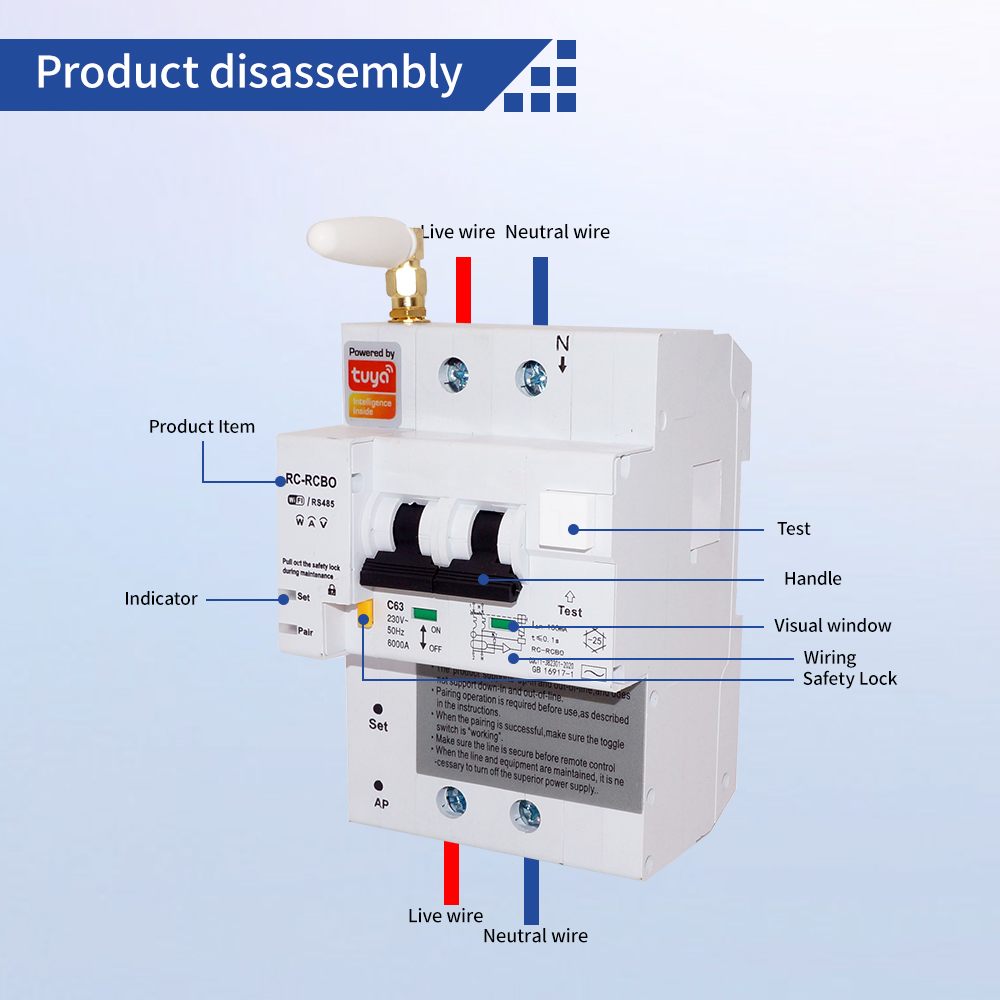
A smart leakage circuit breaker utilizes internal zero-sequence current transformers and microprocessors to detect milliamp-level imbalances between phase and neutral conductors. When the vector sum of these currents deviates from zero, the microprocessor triggers the tripping mechanism. This digital detection allows for precise, programmable responses rather than the binary open/close function of traditional electromechanical devices.
Programmable reclosing sequences follow a structured automated path: trip, dead-time delay, attempt reclose, evaluate, and lockout. High-speed grid auto-reclosing often executes in less than one second to maintain grid stability against transient overhead faults. Smart breakers managing low-voltage leakage require extended, highly controlled delay windows. This delay allows for environmental factors like temporary condensation to dissipate before attempting restoration.
Reclaim time, or the reset timer, represents a critical mechanical and software requirement. The automatic reclosing logic must remain blocked until the circuit breaker has been closed and has remained closed successfully for a predetermined period. If a subsequent fault occurs before the reclaim time expires, the breaker immediately locks out. This logic prevents successive rapid trips, known as hammering, which destroys breaker contacts and exacerbates the fault condition.
Enterprise-grade breakers differentiate fault types to apply appropriate logic. They automatically block the reclose command if the trip was caused by leakage rather than a transient voltage sag or standard overcurrent. This reclose blocking mechanism ensures that permanent insulation failures receive physical inspection rather than automated, dangerous power restoration.
Let's look at a practical configuration sequence for a smart breaker handling a mixed-load panel. You might configure the overcurrent protection to allow two reclose attempts with a 30-second dead time, assuming a motor startup surge caused the trip. However, for the residual current (leakage) protection channel on that exact same breaker, you configure a hard lockout. The microprocessor handles these two distinct logic paths simultaneously, providing granular protection that legacy breakers simply cannot match.
The integration of solid-state relays and advanced microcontrollers allows these devices to log the exact parameters of the trip. When a field technician arrives at the panel, they don't just see a tripped handle. They connect to the breaker and see that it tripped at exactly 42mA of leakage current on Phase B at 03:14 AM. This telemetry is what makes the breaker "smart" and enables targeted, efficient troubleshooting.
Site accessibility heavily influences the decision matrix for enabling auto-reclosing. Remote telecom towers or isolated pumping stations face massive dispatch costs for simple nuisance trips, making highly controlled auto-reclosing attractive. Highly populated commercial buildings or residential environments mandate strict lockouts due to the immediate risk to human life. The evaluation must weigh the necessity of uptime against the probability of human contact with the faulted circuit.
Environmental nuisance tripping occasionally justifies a single, delayed auto-reclose attempt. High humidity, temporary condensation in outdoor enclosures, or heavy rain events can cause transient leakage paths that dry out rapidly. In these specific, well-documented scenarios, a delayed reclose attempt (e.g., 15 minutes post-trip) might successfully restore power without compromising safety, provided the environment is unattended.
Cumulative energy limits define the thresholds for maximum allowable reclosing attempts. Configurations typically cap attempts at one or two within a strict time window before executing a permanent lockout. This limitation prevents terminal degradation of the wiring infrastructure and the breaker contacts. Critical infrastructure uptime, such as server racks or medical cold storage, requires balancing continuous power requirements against the risk of catastrophic electrical failure.
Auto-Reclosing Decision Matrix by Environment | |||
Environment Type | Human Access | Leakage Auto-Reclosing | Required Diagnostics |
|---|---|---|---|
Remote Telecom Tower | Strictly Controlled | Permitted (1 Attempt) | Pre-closing Impedance Check |
Commercial Office Space | High/Public | Strictly Prohibited | Hard Lockout / Manual Reset |
Outdoor Pumping Station | Controlled | Permitted (Delayed) | Insulation Resistance Test |
Data Center Rack | Restricted | Prohibited on Leakage | Telemetry Review Required |
Industrial Manufacturing Floor | High/Worker | Strictly Prohibited | Physical Inspection Required |
When evaluating these criteria, engineers must also consider the specific load characteristics. A circuit feeding outdoor LED lighting might experience capacitive leakage during heavy rain. A single reclose attempt after the rain stops makes operational sense. Conversely, a circuit feeding a hospital operating room must never auto-reclose on a ground fault, as the leakage could be passing through sensitive medical equipment or personnel.
We use a strict scoring system when auditing facilities for auto-reclose suitability. We look at the physical security of the enclosure, the historical fault data, and the response time of the maintenance team. If a site cannot guarantee that unqualified personnel are kept away from the equipment, auto-reclosing on leakage is immediately disqualified, regardless of the operational cost of downtime.
The industry standard configuration dictates a hard lockout on any leakage event. This approach triggers a permanent mechanical and software lockout, requiring a qualified technician to perform a physical inspection and manual reset. This conservative approach guarantees compliance with life-safety regulations and eliminates the risk of re-energizing a circuit actively shocking a person or arcing against combustible material.
Advanced devices offer delayed reclosing with pre-check diagnostics. These breakers inject a low-voltage test signal into the circuit to measure insulation resistance before closing the main contacts. If the impedance remains below a safe threshold, the breaker aborts the reclosing sequence and enters a permanent lockout state. This diagnostic capability is the only technically sound method for automating leakage recovery.
Manual remote intervention utilizes a remote smart MCB to bypass automated reclosing entirely. Engineers review telemetry data—such as fault current magnitude and phase angle—before initiating a manual remote reset. This protocol ensures human oversight and data-driven decision-making, significantly reducing the risk of blind re-energization.
Platform integration facilitates this remote management. A Tuya WiFi smart MCB ecosystem handles notification routing, pushing real-time alerts to facility managers. These platforms allow operators to intercept lockout states, review the exact milliampere leakage that caused the trip, and make informed decisions regarding dispatching personnel or attempting a remote reset based on historical site data.
Implementing these solutions requires a tiered approach to network architecture. The smart breakers must communicate reliably with the central management platform. If the network goes down, the breaker must default to its safest localized logic state—which is always a hard lockout on leakage. Relying on cloud-based logic for life-safety decisions introduces unacceptable latency and failure points.
We frequently deploy hybrid configurations. The breaker handles the immediate trip and lockout locally. It then sends the fault data to the cloud platform. The facility manager receives an alert on their mobile device, reviews the oscillography data, and decides whether to dispatch a technician or initiate a remote diagnostic sequence. This keeps the safety logic localized while centralizing the management and recovery process.
Regulatory and compliance risks govern all auto-reclosing configurations. Strict IEC 61008/61009 and NEC regulations dictate the application of Ground Fault Circuit Interrupters (GFCI) and Residual Current Devices (RCD). These codes generally prohibit automatic reclosing on residual current faults in environments accessible to unqualified personnel. Violating these codes exposes facility operators to severe legal and financial penalties.
Liability and human safety represent the most critical implementation risks. Enabling auto-reclosing on circuits where human contact might be the root cause of the leakage event carries severe liability. If a person receives a shock that trips the breaker, an automated reclose will subject them to a second, potentially fatal shock. Mitigation requires strictly limiting auto-reclosing to verified, unattended environments.
Mitigation via telemetry replaces blind auto-reclosing with root-cause analysis. Data logging features capture time-stamped fault currents, phase angles, and leakage milliampere logs. Analyzing this data allows engineers to identify degrading insulation or environmental patterns before they result in hard failures. Predictive maintenance based on telemetry data provides higher uptime than reactive auto-reclosing.
Another significant risk is software misconfiguration. When deploying hundreds of smart breakers across a facility, a simple copy-paste error in the configuration file can accidentally enable auto-reclosing on critical life-safety circuits. Mitigation requires strict version control of configuration files and mandatory physical commissioning tests where technicians intentionally induce ground faults to verify the lockout logic operates correctly.
Cybersecurity also plays a role in implementation risk. If a malicious actor gains access to the management platform, they could theoretically force breakers to repeatedly close onto active faults, causing physical damage to the facility. Securing the communication channels between the breakers and the management platform using strong encryption and multi-factor authentication is a mandatory mitigation strategy.
Hardware reliability must balance against software flexibility. Hardwired, immutable safety relays offer undeniable reliability for life-safety applications, ensuring that a leakage trip always results in a lockout. Software-defined reclosing logic provides flexibility, allowing updates via firmware to adjust reclaim times or delay windows based on changing site conditions. The ideal hardware combines mechanical safety overrides with flexible software reporting.
The granularity of diagnostic data justifies configuration choices. High-resolution oscillography and detailed event logs in the breaker's dashboard allow engineers to distinguish between a transient moisture event and a hard insulation failure. Hardware that only reports a generic "fault" lacks the necessary context to support remote reset protocols or automated reclosing logic.
Scalability of fleet management determines the viability of enterprise deployments. Managing hundreds of smart breakers requires software that handles bulk configuration of reclosing policies. Enterprise platforms ensure that leakage lockouts are universally enforced across all relevant devices, preventing a single misconfigured breaker from compromising facility safety.
When evaluating hardware, look closely at the mechanical endurance ratings of the internal contacts. A breaker designed for frequent remote switching will have a much higher mechanical lifecycle than a standard breaker retrofitted with a motor operator. If you plan to use the breaker for load shedding or frequent remote resets, ensure the hardware is rated for that duty cycle.
Finally, consider the physical form factor and thermal dissipation. Smart breakers pack microprocessors, communication radios, and motor operators into a very small space. In dense panelboards, thermal management becomes a real issue. Select hardware that provides internal temperature monitoring and will automatically derate or trip if the internal electronics exceed safe operating temperatures.
Automatic reclosing should almost never be enabled for leakage events unless the smart breaker features certified pre-closing impedance diagnostics and the environment is strictly unattended. The physical realities of earth leakage dictate that these faults are permanent and require physical intervention or advanced diagnostic verification before power restoration.
Prioritize smart breakers that offer distinct, programmable logic for different fault types. The ability to separate overcurrent auto-reclosing from leakage lockout is mandatory for safe facility operation. Blindly applying utility-grade reclosing logic to low-voltage distribution introduces unacceptable risks.
Audit your current smart panel configurations immediately to identify any active auto-reclose settings.
Disable blind auto-reclosing on all leakage channels across your entire facility.
Establish a clear remote-reset protocol that requires engineering review of telemetry data before authorization.
Upgrade to hardware that supports pre-closing diagnostics if automated recovery in remote locations is required.
A: Overcurrent auto-reclosing addresses transient overloads or temporary short circuits, often resolving quickly. Leakage auto-reclosing deals with ground faults, which usually indicate permanent insulation failure or human contact, requiring strict lockouts to prevent fires or fatal shocks.
A: Yes, advanced models use pre-closing impedance checks. They inject a low-voltage signal to measure insulation resistance. If resistance is low, the fault is permanent, and the breaker locks out. If normal, the fault was transient.
A: It is only safe if the operator reviews detailed telemetry data confirming the fault has cleared, and the environment is strictly unattended. Remote resets without diagnostic verification risk re-energizing a dangerous fault.
A: For overcurrent, typically 1 to 3 attempts within a specific window. For leakage faults, the standard is zero attempts (immediate lockout) unless pre-closing diagnostics verify the fault is clear.
A: Reclaim time is the mandatory duration a breaker must remain successfully closed after a reclose attempt before the auto-reclose logic resets. If a fault occurs during this time, the breaker locks out permanently.
A: By preventing repeated attempts to close onto an uncleared fault, reclose blocking stops the accumulation of thermal energy at the fault site, preventing insulation degradation and localized ignition.
A: Generally, no. Codes like the NEC and IEC strictly prohibit automatic reclosing on residual current or ground faults in environments accessible to people, mandating manual inspection and reset for life safety.


