Views: 0 Author: Site Editor Publish Time: 2026-10-12 Origin: Site
Let us cut straight to the chase. The rapid evolution of the Internet of Things has completely transformed traditional electrical distribution. A smart circuit breaker is no longer a futuristic luxury. It is an indispensable component for modern building automation and energy management. Legacy distribution boards often lead to massive maintenance costs and hidden safety risks. Modern system integrators need scalable, data-driven energy solutions to stay competitive. This comprehensive guide breaks down the intricate details of deploying these intelligent electrical safety devices. From physical hardware installation to advanced cloud integration and OEM project deployment, you will acquire the actionable, field-tested insights necessary to seamlessly weave these modules into enterprise networks.
Scalable Integration: Leverage the cloud IoT platform to manage hundreds of devices from a single, centralized dashboard seamlessly.
Enhanced Safety: Understand the critical role of advanced leakage protection in preventing electrical fires and catastrophic equipment damage through precise, real-time monitoring.
Remote Management: Discover how an intelligent breaker enables over-the-air firmware updates, remote switching, and highly automated energy distribution for large-scale facilities.
Step-by-Step Configuration: Master the exact network pairing protocols, API integration methods, and troubleshooting steps required for flawless commercial project execution.
OEM Opportunities: Identify the best hardware choices, such as DIN-rail LCD models and 3P industrial breakers, for customized, white-label client solutions.
Recent industry shifts reveal a massive pivot toward decentralized, intelligent power grids. Driven by stringent Environmental, Social, and Governance compliance mandates and soaring global energy costs, commercial property developers refuse to settle for passive safety devices. They require active energy nodes capable of predictive analytics and automated load shedding. Consequently, system integrators who fail to adopt IoT-enabled distribution boards risk being phased out by more technologically agile competitors. The market now demands hardware that not only protects circuits but also actively communicates system health.
For decades, electrical distribution relied heavily on traditional electromechanical breakers. These devices were designed solely to trip during thermal overloads or magnetic short circuits. Are they effective for basic safety? Absolutely. However, they offer zero visibility into energy consumption. They also require manual, on-site intervention for resetting or diagnostics. The modern intelligent breaker changes the paradigm. It integrates microprocessors, solid-state relays, and communication modules into the standard DIN-rail form factor. This evolution marks a critical shift from reactive, manual switching to proactive, automated, and data-driven electrical management. System integrators can now monitor voltage, current, active power, and temperature in real-time. This effectively transforms a passive safety device into an active, communicative network node.
System integrators are rapidly moving toward smart panels due to the measurable bottom-line value they deliver to commercial clients. In demanding environments like hotels, industrial plants, and smart apartment complexes, operational expenditure is heavily tied to energy consumption and maintenance. Furthermore, deploying connected breakers allows facility managers to implement predictive maintenance. Imagine a facility manager at a sprawling hotel complex receiving a smartphone alert about an abnormal 45A current draw on a third-floor HVAC unit. This happens hours before the compressor actually fails. This level of foresight allows maintenance teams to identify abnormal current draws before catastrophic equipment failure occurs. Meanwhile, automated scheduling drastically reduces energy waste during off-peak hours.
When selecting IoT hardware, the underlying software ecosystem is just as crucial as the physical components inside the plastic housing. A Tuya smart circuit breaker is highly desirable for system integrators. The platform offers robust cloud stability, a global server presence, and extensive API availability. It provides a standardized communication framework that seamlessly bridges the gap between raw hardware and enterprise software. Specifically, integrators must choose the right communication protocol based on the project environment. Wi-Fi models are cost-effective and connect directly to local routers, making them suitable for smaller retail setups. Zigbee models require a dedicated gateway but offer superior mesh networking and lower power consumption. This makes Zigbee ideal for dense deployments in multi-story office buildings.
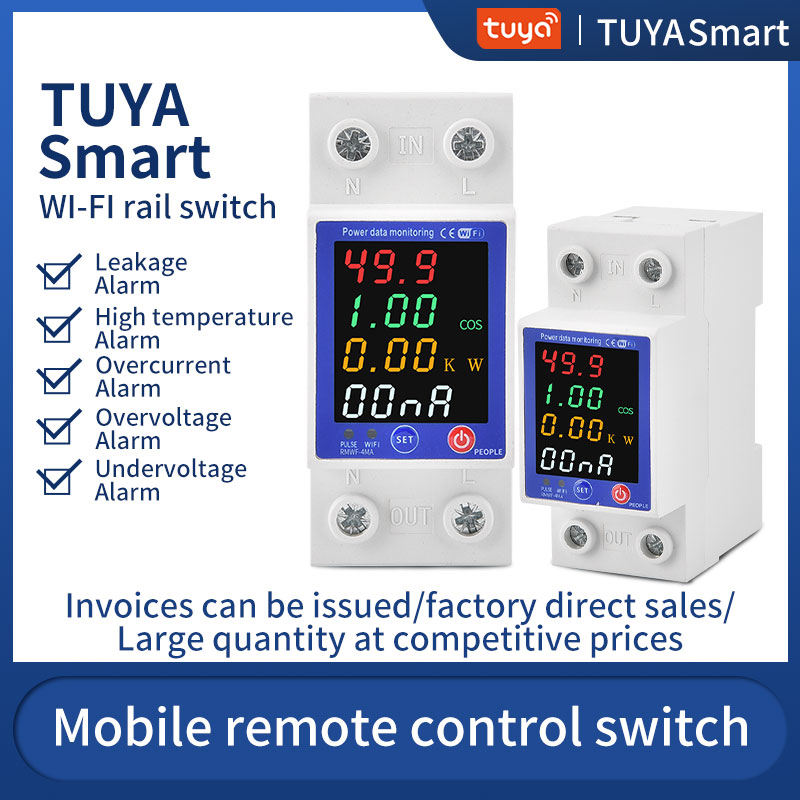
One of the most significant advantages of this ecosystem is the unparalleled ability to create customized, white-label solutions. Integrators are not forced to use generic consumer applications. Instead, they can utilize the platform SDK to develop fully branded applications tailored to specific operational workflows. Hardware customization is equally viable and highly encouraged. Manufacturers offer OEM opportunities to integrate DIN-Rail LCD displays directly onto the faceplate. This allows on-site technicians to read localized diagnostics, current loads, and error codes instantly without needing to authenticate a smartphone or tablet.
Safety and strict regulatory compliance dictate the physical installation process. Standard 1P and 2P models are typically wired for single-phase residential or light commercial loads. Heavy three-phase industrial distribution requires robust 3P and 4P models. Devices must be securely mounted on a standard 35mm DIN rail. Before applying power, integrators must ensure the incoming Line and Neutral wires are stripped to exactly 10mm. Torque them to the manufacturer specifications, usually around 2.5 Nm, to prevent micro-arcing. Once powered up, the device LED indicator provides immediate diagnostic feedback. A fast-blinking blue or green light indicates the module is actively scanning for a network. A solid light confirms a successful, stable connection.
Connecting the breaker to the local network is typically executed via the designated mobile application. In EZ Mode, ensure the smartphone is connected to a 2.4GHz Wi-Fi network. The 5GHz bands will cause the initial handshake to fail. Put the breaker into fast-blinking mode by holding the pairing button for five to ten seconds. Enter the Wi-Fi credentials, and the cloud will automatically broadcast the payload to the device. In complex commercial environments with heavy firewall restrictions or aggressive mesh network steering, EZ mode may time out. Consequently, Access Point mode acts as a highly reliable fallback. By holding the button until the LED blinks slowly, the breaker broadcasts its own local hotspot. The integrator connects their phone directly to this hotspot to pass the network credentials locally, completely bypassing external network interference.
For enterprise-level deployments, basic app-level control is entirely insufficient. Integrators must link the device to the Developer Platform. By creating a Cloud Development Project, integrators can extract the unique Device ID, Client ID, and Client Secret. These cryptographic credentials allow for secure API calls. You can pull real-time telemetry data or push control commands to third-party platforms, such as custom Building Management Systems or open-source platforms like Home Assistant.
Standard smart breakers primarily protect against overcurrent and short circuits. In contrast, a smart leakage circuit breaker incorporates a highly sensitive Zero-Sequence Current Transformer. This internal sensor continuously monitors the balance of current flowing between the Line and Neutral wires. If the returning current is even slightly less than the outgoing current, it indicates that power is leaking to the earth. This leakage could potentially travel through a human body or degraded wiring insulation. The breaker detects this residual current and trips the mechanical relay instantly. This action prevents fatal electric shocks and mitigates hidden fire hazards.
Through the configuration interface, integrators can set precise, customized parameters for leakage protection. Standard human safety thresholds are typically locked at 30mA. This ensures immediate power cutoff within milliseconds of fault detection. However, industrial equipment often experiences natural background leakage. Integrators can adjust alert thresholds to notify maintenance teams via push notifications before a hard trip actually occurs. This drastically reduces troubleshooting time by pinpointing the exact circuit experiencing the fault. Most advanced models also feature a remote self-test function. Administrators can verify the mechanical integrity of the leakage sensor without ever opening the physical electrical panel.
Managing individual circuits one by one is highly inefficient in sprawling commercial facilities. The platform allows system integrators to logically group multiple remote smart MCB units. Devices can be categorized by floor, building sector, or specific functions. For example, you can group all exterior lighting circuits or heavy-duty HVAC breakers together. Facility managers can then utilize a single-tap master switch on their customized dashboard. This allows them to power down entire operational zones during emergencies, facility lockdowns, or routine maintenance windows.
The true value of a connected distribution board lies in its automation capabilities. Integrators can program complex, logic-based rules using the cloud engine. A rule can be established stating that if total energy consumption on the main feed exceeds 500 kWh, non-essential secondary circuits automatically turn off. This prevents peak demand utility charges. Time-based scheduling is also standard practice. Water heating circuits can be programmed to power down automatically at 10:00 PM and reliably resume at 6:00 AM. This ensures consistent energy savings without relying on human memory.
Data is the absolute foundation of modern energy management. These intelligent breakers provide granular telemetry, including real-time voltage, current, and active power. Integrators can use the API to export historical energy consumption data into external SQL databases for advanced analytics. This data is critical for generating transparent client reports. It helps allocate departmental energy billing and mathematically verify the return on investment of facility energy-saving initiatives.
A frequent challenge in commercial deployments is maintaining stable Wi-Fi connectivity. These IoT devices only support 2.4GHz bands for better concrete wall penetration. Dual-band routers with aggressive band-steering can cause devices to drop offline unexpectedly. Integrators should isolate the 2.4GHz network with a dedicated, hidden SSID. In addition, metal distribution boxes act as literal Faraday cages, severely degrading wireless signals. To resolve this frustrating issue, integrators should source breaker models equipped with external SMA antenna ports. This allows the antenna to be magnetically mounted outside the metal enclosure for a crystal-clear signal.
When integrating with custom software, devices may occasionally show as offline on the developer platform despite having local physical power. This is almost always related to API rate limits. The cloud imposes strict token refresh protocols and API call frequency limits to prevent server overloads. Integrators managing large-scale deployments must optimize their code. Subscribe to MQTT message queues for state changes rather than continuously polling the REST API. Continuous polling will inevitably lead to temporary IP bans.
Over-The-Air firmware updates are essential for patching security vulnerabilities and improving measurement accuracy algorithms. However, pushing an update to a breaker temporarily disrupts its processing unit, which can cause a brief relay reset. Integrators must implement staggered update schedules during strict off-peak hours, such as 3:00 AM, to ensure facility power is not unintentionally interrupted. Post-update, it is best practice to verify the voltage calibration against a certified digital multimeter. This ensures energy monitoring accuracy remains within the stated tolerance.
Hardware selection must align strictly with the electrical load and environmental requirements of the specific project. Do not guess; match the specifications to the field reality. For residential smart home upgrades or individual hotel rooms, standard 1P or 2P single-phase models are perfectly sufficient. Conversely, industrial motor control centers and heavy-duty commercial HVAC systems require incredibly robust 3P or 4P models. These must be capable of handling three-phase power and higher short-circuit breaking capacities, such as 6kA or 10kA.
Application Scenario | Recommended Pole Type | Key Parameter Focus | Communication Protocol | Best For |
|---|---|---|---|---|
Smart Apartments & Hotels | 1P / 2P | 10A-63A, 30mA Leakage | Wi-Fi / Zigbee | Lighting, HVAC, Water Heaters |
Commercial Office Floors | 2P with LCD Display | Energy Metering, API Sync | Zigbee / Ethernet | Sub-metering, Building Management Integration |
Industrial Motor Control | 3P / 4P | 100A Max, 6kA Breaking Capacity | RS485 / Wi-Fi | Heavy Machinery, Three-Phase Loads |
Retrofit OEM Projects | DIN-Rail LCD Models | White-label UI, Custom Thresholds | Wi-Fi | Custom Branded Client Solutions |
System integrators must vet their hardware suppliers rigorously. Evaluating manufacturers based on international safety certifications, such as CE, RoHS, and CB, is absolutely non-negotiable. Furthermore, production capacity and direct OEM technical support dictate exactly how smoothly a white-label project will scale from prototype to mass deployment. Choosing a dedicated smart electrical manufacturer, rather than a generic IoT gadget factory, ensures much better hardware-software synergy. It guarantees superior arc-extinguishing chamber design and long-term mechanical reliability in the field.
Configuring a smart circuit breaker is a highly logical, structured process. It yields massive dividends in terms of facility control, electrical safety, and overall energy efficiency. For system integrators, mastering this technology is the key to delivering future-proof electrical solutions. From deploying standard remote modules to configuring highly sensitive leakage protection, the benefits are undeniable. By leveraging robust cloud ecosystems and partnering with reliable OEM manufacturers, integrators can easily scale their operations. They can offer premium white-labeled solutions and secure a definitive competitive edge in the rapidly growing smart building market. Ready to upgrade your project portfolio? Explore the extensive range of high-performance electrical solutions at People Elect. Start testing and integrating intelligent breakers today to see the immediate, measurable impact on your energy management systems.
Yes. While an active internet connection is required for remote control, automated scene execution, and historical data logging, the core safety features will continue to function locally. The mechanical protections against short-circuits, overloads, and manual switching operate entirely independent of the Wi-Fi network. This ensures the facility remains safe during internet outages.
A standard smart circuit breaker primarily protects the electrical circuit against overloads and short circuits while offering remote switching capabilities. A smart leakage circuit breaker incorporates an additional highly sensitive sensor designed to detect residual current. This instantly cuts power upon detecting a leakage fault, specifically preventing human electrical shocks and localized electrical fires.
Integrators utilize centralized developer platforms or a custom Building Management System integrated via secure APIs. This robust architecture allows for centralized management, batch configuration, over-the-air updates, and comprehensive energy monitoring across multiple geographical sites from a single, unified dashboard.
Yes. Through Cloud APIs and local SDKs, system integrators can extract device telemetry data and send control commands. This allows the breakers to be seamlessly integrated into third-party automation platforms like Home Assistant, openHAB, or bespoke enterprise energy software used by large commercial clients.
Absolutely. Reputable manufacturers offer specialized 3P and 4P models designed specifically for high-load, three-phase industrial power distribution. It is crucial for integrators to ensure the selected breaker strictly matches the specific voltage, maximum amperage, and regulatory certification requirements of the harsh industrial environment.
When a breaker trips due to a physical fault like a short circuit or severe overload, safety protocols require a manual physical reset at the distribution board. Remote resetting is typically disabled after a critical fault trip to ensure a technician inspects the circuit for damage before restoring power. For software-triggered automation shutdowns, remote resetting is fully supported.
Yes. By utilizing the real-time energy monitoring and automation features, facility managers can implement automated load shedding. When the system detects that total facility power consumption is approaching the utility peak demand threshold, the smart breakers can automatically disconnect non-essential loads, such as decorative lighting or secondary water heaters, preventing expensive peak demand penalties.