
Views: 0 Author: Site Editor Publish Time: 2026-09-05 Origin: Site


Exporting non-compliant electrical components carries massive financial and reputational stakes. A rejected shipment at customs, a regulatory penalty, or a catastrophic failure in a foreign electrical grid can permanently damage an exporter's market presence. When shipping safety-critical devices across borders, standard end-of-line factory checks fall short. The core business problem lies in bridging the gap between domestic manufacturing standards and stringent international operational requirements. A single phase voltage protector must survive harsh transit conditions, pass rigorous destination-country customs inspections, and function flawlessly under highly variable foreign grid conditions.
To mitigate these risks before a shipment leaves the facility, exporters must implement a standardized, evidence-based inspection framework. This protocol validates product reliability, ensures strict regulatory compliance, and assesses export authorization risks. By shifting the focus from reactive troubleshooting to proactive pre-shipment validation, importers and distributors can secure their supply chains and guarantee field safety.
Pre-export inspection of a voltage protector requires dual validation: electrical performance testing (trip accuracy, response time) and international regulatory compliance (CE, UL, RoHS, and export control classifications).
Testing protocols must simulate the destination country's specific grid anomalies, particularly when evaluating an over under voltage protector for regions with high grid instability.
Visual and mechanical inspections must strictly verify cable termination interfaces and destination-specific conductor color codes for 1-phase circuits to prevent installation hazards.
Establishing strict Acceptable Quality Limit (AQL) standards for batch sampling prevents systemic failures and reduces the risk of mass export rejection.
Proper documentation, including verifiable test reports, localized labeling, and EEE (Electrical, Electronic, and Electromechanical) compliance records, is as critical as the physical inspection for seamless customs clearance.
Defining a successful export order requires looking beyond the factory floor. A truly successful transaction results in zero customs delays, zero dead-on-arrival units, and full compliance with both buyer specifications and international EEE guidelines. When a voltage protector arrives at its destination, it must immediately integrate into the local infrastructure without triggering safety audits or installation bottlenecks. Achieving this requires a pre-export inspection strategy that treats the product as a critical infrastructure component rather than a generic commodity.
Skipping rigorous inspections initiates a cascade of severe financial consequences. The immediate cost of failure includes reverse logistics, which often exceed the manufacturing cost of the goods themselves. Defective shipments trigger breach of contract penalties, prolonged legal disputes, and the permanent loss of international buyer trust.
Consider the direct impacts of failed pre-shipment quality control:
Customs Impoundment: Missing CE marks or incorrect documentation leads to immediate seizure at the port of entry, incurring daily storage fees.
Field Failures: Devices that fail to trip during a surge cause catastrophic damage to downstream appliances, leading to massive liability claims.
Rework Costs: Dispatching technicians to a foreign country to replace faulty terminal blocks destroys project margins.
Brand Degradation: Distributors will quickly drop suppliers that consistently deliver non-compliant or unsafe electrical components.
Relying solely on domestic manufacturing standards is a massive error in international trade. Standard end-of-line testing typically assumes stable local grid conditions and benign operating environments. Export markets demand environmental stress screening to simulate extreme temperatures and humidity during transit. Destination-specific compliance checks must align perfectly with the buyer's incoming inspection protocols. What passes a basic functional test in the manufacturing facility will often fail a rigorous third-party EEE incoming inspection if it lacks proper documentation, accurate labeling, or precise trip thresholds calibrated for the destination grid.
Physical integrity forms the baseline of any electrical component inspection. Inspectors must rigorously evaluate the housing durability, ensuring the use of certified flame-retardant polymers. For DIN-rail mounted devices, the plastic must meet V-0 flammability ratings under UL 94 standards. Terminal block security is non-negotiable. Inspectors apply precise torque tests using calibrated screwdrivers to verify that screws will not loosen during high-vibration transit. For a standard 63A device, terminal screws typically require a tightening torque of 2.0 to 2.5 Nm.
Modern inspection frameworks incorporate Automated Optical Inspection (AOI) principles before the final housing assembly. AOI scans the internal printed circuit boards (PCBs) to verify solder joint integrity, component placement, and the absence of solder bridges. This step prevents premature field failures caused by micro-cracks in the solder that expand under thermal stress.
Localized labeling verification is a strict regulatory requirement. Inspectors must cross-reference the printed voltage ratings, wiring diagrams, and certification marks against the export destination's legal mandates. A missing CE mark or an incorrect frequency rating triggers immediate customs impoundment.
Furthermore, inspectors must mandate the examination of cable termination interfaces. Proper labels must be provided near terminations to identify conductor assignments clearly. Inspectors must verify that any pre-installed cables or designated conductor color codes for 1-phase circuits strictly comply with the destination's electrical code.
Region / Standard | Live (L) Conductor | Neutral (N) Conductor | Earth/Ground (E) Conductor |
|---|---|---|---|
Europe (IEC) | Brown | Blue | Green-Yellow |
North America (NEC) | Black | White | Green or Bare Copper |
Australia / New Zealand (AS/NZS) | Brown or Red | Light Blue or Black | Green-Yellow |
Mismatched color coding creates severe installation hazards and guarantees rejection during incoming QA checks.
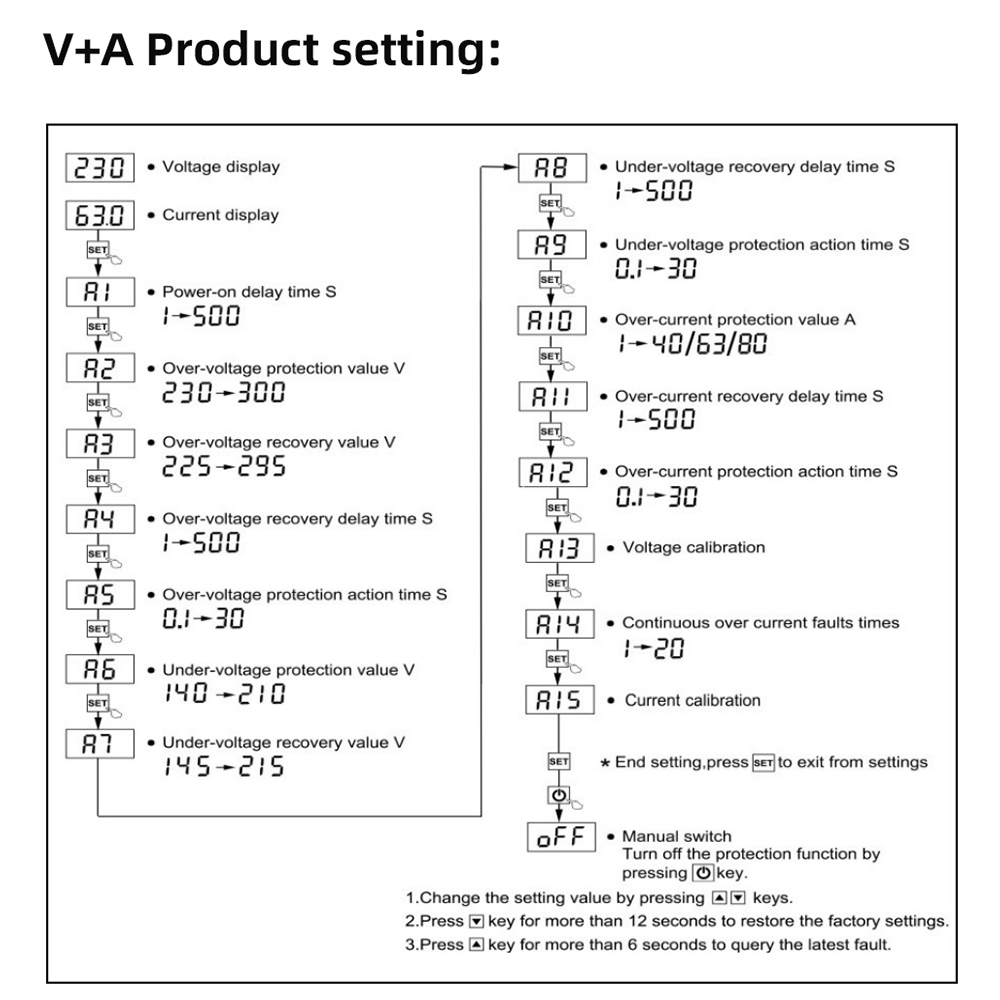
Bench testing validates the core protective functions of the device. When evaluating an over under voltage protector, technicians use variable autotransformers to simulate grid fluctuations. The inspection must verify precise cut-off thresholds. If a device is rated to trip at 270V, the relay must open exactly at that threshold, with a standard tolerance of ±1%. Hysteresis evaluation is equally necessary; the device must not rapidly toggle on and off if the grid voltage hovers right at the trip threshold. The recovery voltage is usually set 5V to 10V below the trip voltage to prevent this relay chatter.
Safety under high-stress conditions requires dielectric withstand testing, commonly known as Hi-Pot testing. Inspectors apply a high voltage—typically 1500V to 2000V AC—between the current-carrying conductors and the external casing for 60 seconds. This test ensures the internal insulation can withstand transient spikes without breaking down and shocking the user. Insulation resistance testing follows, using a megohmmeter at 500V DC to confirm that the resistance between isolated circuits exceeds standard safety minimums, usually greater than 50MΩ.
Contextualizing the inspection scope requires understanding the differences in network architectures. The testing parameters shift significantly based on the phase configuration of the intended grid.
Inspection Parameter | Single Phase Units | Three Phase Units |
|---|---|---|
Primary Focus | Neutral line integrity, precise L-N over/under voltage trip accuracy. | Phase sequence, phase asymmetry, phase loss validation. |
Voltage Monitoring | Monitors a single Line-to-Neutral voltage. | Monitors three separate Line-to-Line or Line-to-Neutral voltages simultaneously. |
Failure Modes | Neutral faults, extreme grid surges, brownouts. | Motor reversal (due to phase sequence errors), motor overheating (due to asymmetry). |
Testing Equipment | Single-channel variable autotransformer, standard oscilloscopes. | Three-phase power quality simulators, multi-channel analyzers. |
While a three phase voltage protector requires complex validation of phase sequence and asymmetry to protect heavy industrial motors, single phase inspection focuses heavily on neutral line integrity and precise over/under voltage trip accuracy to protect sensitive commercial and residential appliances.
Acceptable latency between a voltage anomaly and the physical relay disconnection defines the protective value of the device. Response time is a non-negotiable evaluation metric for international buyers. Inspectors measure this latency in milliseconds using digital storage oscilloscopes.
Microsecond delays directly impact downstream sensitive equipment. If a high-voltage surge hits a circuit, a delay of 500 milliseconds might be acceptable for a basic resistive heating element, but it will instantly destroy the microprocessors in medical equipment or server racks. The inspection must verify that the relay actuates within the specified timeframe—often under 0.1 seconds for severe overvoltage—to physically isolate the load before the surge propagates through the system.
The auto-recovery function requires meticulous evaluation. Once the grid voltage stabilizes, the device must reconnect power automatically. However, immediate reconnection is dangerous for specific loads. Inspectors must test the delay timer, typically adjustable between 1 and 5 minutes, to ensure it functions accurately.
This delay prevents rapid cycling during intermittent grid failures. Compressor-based appliances, such as commercial refrigerators and HVAC units, require time for internal refrigerant pressures to equalize after a power drop. If the protector restores power immediately, the compressor motor will stall against the high head pressure, draw massive locked-rotor current, and burn out the motor windings. Validating the accuracy of this countdown timer prevents catastrophic downstream equipment failure.
Exporting electrical devices requires absolute certainty regarding their current-carrying capabilities. Continuous load testing procedures push the device to its maximum rated current, such as 40A or 63A, for extended periods, often up to four hours. Inspectors monitor the device to ensure the internal relay contacts do not weld shut under maximum load.
Thermal stability is evaluated concurrently using thermal imaging cameras or thermocouple probes. Inspectors scan the terminal blocks, internal relay contacts, and the external housing during the continuous load test.
Component | Max Temperature Rise (Kelvin) | Potential Failure Mode if Exceeded |
|---|---|---|
Terminal Blocks | 45K | Loose connections, wire insulation melting, arcing |
Relay Contacts | 65K | Contact welding, premature mechanical wear |
External Housing | 30K | Plastic deformation, user burn hazard, DIN-rail warping |
A temperature rise exceeding these standard limits indicates high contact resistance, poor internal riveting, or inadequate conductor cross-sections. Identifying these thermal anomalies during pre-export inspection prevents severe fire hazards during sustained field operation.
Electrical grids vary drastically across regions, making compatibility testing a strict requirement. Inspectors must test the device against the destination's specific frequency. A magnetic relay coil designed strictly for 50Hz may chatter, overheat, or fail to actuate properly on a 60Hz grid.
Nominal voltage testing is equally necessary. A device destined for North America must be calibrated for 110V/120V systems, while units bound for Europe or Asia must operate accurately at 220V/230V/240V. Applying a 230V testing protocol to a 120V-rated batch will result in immediate failure, highlighting the need for localized inspection parameters.
Physical testing is useless if the shipment is seized due to paperwork discrepancies. A compliant export toolkit requires a comprehensive audit of all accompanying documentation. Inspectors must verify Certificates of Conformity (CoC) and review the Bill of Materials (BOM) to ensure RoHS compliance, confirming the absence of restricted hazardous substances like lead, mercury, and cadmium.
Export authorization requirements demand careful scrutiny. Modern protectors often contain microcontrollers or smart relays. Inspectors must assess these components against export control classifications, such as ECCN checks, to ensure they do not trigger dual-use export control delays.
Finally, verifying the authenticity of certification marks is mandatory. Inspectors must cross-reference CE, CB, or UL marks printed on the product against the supplier's provided third-party lab test reports. Counterfeit certification marks lead to immediate customs rejection and severe legal penalties for the importer.
Inconsistent manufacturing quality poses a massive risk to bulk export orders. Inspecting every single unit is rarely cost-effective, necessitating the use of statistical sampling. Inspectors must apply specific ISO 2859-1 Acceptable Quality Limit (AQL) levels to evaluate the batch.
For critical electrical components, standard practice dictates stringent AQL thresholds. A common configuration is Level II sampling with Critical defects set at 0, Major defects at 1.5, and Minor defects at 4.0.
Defect Category | AQL Level | Example Defect | Batch Action |
|---|---|---|---|
Critical | 0.0 | Failed Hi-Pot test, missing earth terminal, exposed live parts | Reject entire batch immediately |
Major | 1.5 | Trip threshold out of tolerance by 5%, non-functioning display | Reject if count exceeds statistical limit |
Minor | 4.0 | Scratched housing, slightly misaligned label, minor packaging dent | Acceptable within statistical limits |
The best product will fail upon arrival if the packaging cannot survive international freight. Inspectors evaluate both primary and secondary packaging materials. They conduct drop tests following ISTA standards to ensure the internal components do not dislodge upon impact.
Maritime shipping introduces severe environmental risks. Inspectors must evaluate the packaging's ability to withstand high humidity and salt fog. The inclusion of desiccants, vacuum-sealed moisture barrier bags, and sturdy, double-corrugated export cartons are verified to prevent corrosion of the terminal blocks during weeks at sea.
When an inspection fails, a structured mitigation process prevents shipment delays and relationship breakdowns. Buyers must implement a framework for handling non-conformance immediately upon detection.
This framework relies on Corrective and Preventive Action (CAPA) reports. The process follows strict steps:
Containment: Quarantine the defective batch to prevent accidental shipment.
Root Cause Analysis: The supplier must identify why the failure occurred, such as a miscalibrated testing machine on their assembly line.
Corrective Action: Implement immediate fixes, like recalibrating the equipment or replacing faulty components.
Preventive Action: Update standard operating procedures to ensure the defect does not recur in future production runs.
Clear rework protocols and re-inspection terms must be defined in the initial purchase agreement, stipulating who bears the cost of the secondary inspection. To prevent future friction, the supplier's outgoing Quality Assurance processes must be formally aligned with the buyer's incoming EEE inspection guidelines. This alignment ensures both parties test to the exact same standards, eliminating discrepancies upon delivery.
A rigorous, documented inspection protocol is the only reliable method to secure export investments and guarantee product safety. Relying on basic factory checks exposes exporters to unacceptable levels of risk. By mandating comprehensive electrical performance testing alongside strict regulatory compliance audits, buyers ensure their shipments clear customs smoothly and perform safely in the field.
Selecting the right inspection partner or building an internal QA team requires strict shortlisting criteria. Decision-makers must prioritize domain expertise in EEE components, deep knowledge of destination-specific electrical regulations, and access to accredited, calibrated testing equipment. Generalist inspection agencies often lack the technical depth required to evaluate microsecond relay response times or complex AQL sampling for safety-critical devices.
Take immediate action to protect your supply chain:
Audit your current pre-shipment inspection checklists to ensure they include destination-specific grid simulations and Hi-Pot testing.
Request detailed, unedited third-party test reports from your manufacturers prior to authorizing final balance payments.
Align your AQL sampling standards with international best practices, enforcing a strict "Critical 0" tolerance for safety defects.
Standardize your documentation review process to verify RoHS compliance and ECCN classifications before booking freight.
A: Industry-standard Acceptable Quality Limits (AQL) for electrical components typically follow ISO 2859-1 Level II. The standard thresholds are Critical 0 (no safety hazards allowed), Major 1.5 (strict limits on functional defects), and Minor 4.0 (moderate tolerance for cosmetic flaws). Any critical failure rejects the entire batch.
A: Testing requires a variable autotransformer to simulate grid fluctuations and verify precise trip thresholds. Inspectors also measure trip response time using oscilloscopes, validate destination-specific frequency compatibility (50Hz vs 60Hz), and conduct Hi-Pot testing to ensure insulation integrity under high-stress conditions.
A: Conductor color codes for 1-phase circuits vary strictly by region. Europe uses Brown/Blue/Green-Yellow, while North America uses Black/White/Green. Non-compliance leads to immediate failure during incoming inspections and creates severe installation hazards for local electricians.
A: A compliant export toolkit requires Certificates of Conformity (CoC), third-party lab test reports verifying CE/UL marks, a Bill of Materials (BOM) proving RoHS compliance, commercial invoices, and export authorization checks (ECCN) to clear dual-use restrictions.
A: Auto-recovery delay testing ensures the device waits 1 to 5 minutes before restoring power after a grid failure. This delay is critical to protect compressor-based loads (like refrigerators and HVAC units) from rapid power cycling, which can stall motors and cause burnouts.
A: No. While single-phase testing focuses on neutral line integrity and over/under voltage limits, three-phase units require additional, complex validation. Inspectors must test for phase sequence errors, phase asymmetry, and phase loss to protect heavy industrial motors from reversing or overheating.
A: The most frequent failures include localized labeling errors, incorrect termination interfaces or wire colors, failed Hi-Pot tests indicating poor insulation, and inaccurate trip thresholds where the device fails to disconnect at the specified voltage limit.


