
Views: 0 Author: Site Editor Publish Time: 2026-09-02 Origin: Site


Dispatching technicians to distributed sites for simple power resets drains maintenance budgets and extends downtime. When a breaker trips at an unmanned telecom tower or edge data center, the equipment stays dead until a human arrives. Facility managers face a hard reality. They must balance the operational efficiency of remote power accessibility with strict network cybersecurity requirements. You cannot compromise localized electrical safety just to save a trip. Distributed infrastructure demands a robust approach to power management. We need a framework for evaluating, selecting, and implementing a remote control architecture that satisfies both IT security mandates and electrical compliance standards. Integrating a smart circuit breaker into your distribution network provides the necessary telemetry and control. It bridges the gap between physical power distribution and digital oversight, keeping sites online without rolling a truck.
Evaluate smart circuit breaker solutions based on localized outage behavior—specifically, how the device manages load states when the control network fails or power is restored.
Match the communication protocol to the site's risk profile; enterprise environments demand secure, localized IP access over consumer-grade cloud dependencies.
Prioritize devices that combine remote actuation with integrated smart leakage circuit breaker capabilities to ensure comprehensive fault protection and telemetry.
Account for physical override mechanisms and manual fail-safes to maintain strict compliance with safety lockout/tagout (LOTO) procedures.
Unmanned infrastructure requires constant uptime. Telecom towers, remote servers, retail branches, and edge data centers operate in isolated environments. When a localized fault occurs, dispatching a technician incurs immediate labor and travel expenses. The hidden cost of this process is prolonged system downtime. Equipment remains offline while maintenance personnel navigate to the site. Remote actuation eliminates this delay. Operators can diagnose and reset tripped circuits from a centralized control room. This capability restores power to systems within seconds rather than hours.
Establishing baseline ROI metrics requires tracking historical maintenance data. You must calculate the true financial impact of manual power resets before approving new hardware deployments. Follow these steps to quantify your current operational losses:
Extract the total number of nuisance trips across all distributed sites over the past twelve months.
Calculate the average travel time for field technicians to reach these specific remote locations.
Multiply the travel and on-site repair time by the fully burdened hourly rate of your maintenance staff.
Determine the hourly revenue lost for each specific site while the equipment remains offline.
Add the labor costs and lost revenue to establish the baseline cost of manual intervention.
Implementing automated load shedding and remote cycling drastically reduces these recurring expenses. The initial capital expenditure for remote switching hardware is often recovered within the first year of deployment. You stop paying highly skilled technicians to drive three hours just to flip a switch.
Remote power management extends beyond emergency resets. It provides a mechanism for proactive energy conservation. Distributed sites often house non-critical equipment that runs continuously. Lighting, auxiliary cooling, and secondary network switches consume baseline power even during off-peak hours. Operators can leverage remote control capabilities to drive energy savings. You can schedule automated power-downs for specific circuits based on site occupancy or operational schedules. This precise control reduces unnecessary energy consumption across hundreds of locations simultaneously.
Consider an unmanned pumping station. The primary pumps require constant power, but the perimeter lighting and secondary ventilation fans do not. A programmable logic controller can interface with the breaker to de-energize these secondary loads during daylight hours. This automated load management also enhances operational flexibility during grid instability. When utility power fluctuates, distributed offices and edge sites face potential equipment damage. Remote switching allows facility managers to shed non-essential loads instantly.
This action preserves backup battery capacity for critical servers and communication arrays. Integrating programmable logic into your power distribution strategy optimizes energy usage. It ensures that available power is directed only where it is most needed during an emergency. You extend the runtime of your uninterruptible power supplies by dropping the loads that do not matter.
Modern power distribution bridges operational technology (OT) with information technology (IT). This convergence introduces significant efficiency gains but also creates potential attack vectors. Connecting a power distribution panel to a network requires strict security protocols. You must prevent unauthorized access to physical infrastructure. A compromised circuit breaker could allow malicious actors to disable site operations. Therefore, bridging OT and IT must not introduce vulnerabilities to the broader enterprise network. Network segmentation is mandatory for all remote power deployments.
Success depends on defining acceptable latency, uptime requirements, and data sovereignty. Remote monitoring systems must provide real-time telemetry without overwhelming available bandwidth. Data sovereignty dictates where operational logs and control commands are stored and processed. Enterprise environments typically require localized data retention. Relying on external servers for infrastructure control is unacceptable.
Your architecture must guarantee that remote actuation commands execute instantly, even under heavy network load. Reliability in the communication layer is just as important as the mechanical reliability of the breaker itself. If the network drops packets, the breaker might not receive the trip command. You must implement Quality of Service rules on your routers to prioritize OT traffic over standard IT data.
Facility managers must choose between retrofitting existing infrastructure or deploying entirely new panels. Standalone breakers offer a targeted approach. You can replace specific traditional MCBs with smart variants to gain remote control over critical circuits. This method minimizes installation time and avoids full panel replacements. It is ideal for legacy sites where only a few specific loads require remote management. You simply snap the new device onto the existing DIN rail and land the communication wires.
However, managing dozens of standalone devices across a single site can complicate network configurations. Each device may require its own IP address and monitoring dashboard. You also have to manage the physical space inside the enclosure. Smart breakers often occupy more DIN rail modules than standard breakers due to the integrated motor operator and communication chipset.
Fully integrated smart Power Distribution Panels provide a cohesive solution for new site builds. These panels arrive pre-wired with unified communication buses. A single network gateway manages all internal breakers. This architecture streamlines deployment and simplifies IP management. Operators gain unified visibility into the entire panel through a single interface. Integrated panels often feature shared power supplies for the communication modules. This design ensures that monitoring capabilities remain active even if individual branch circuits trip.
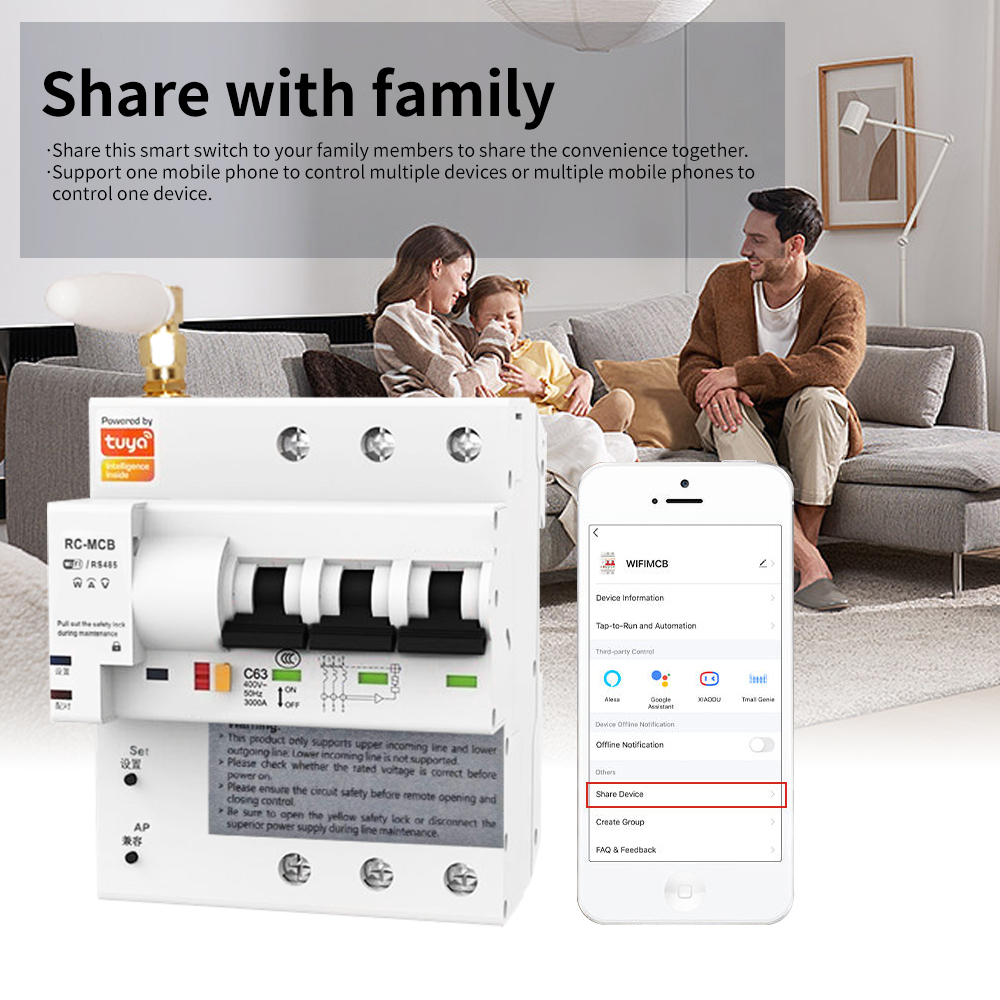
Certain isolated or temporary applications do not require enterprise-grade infrastructure. Small remote offices, pop-up retail locations, or temporary construction sites often utilize accessible wireless networks. In these scenarios, assessing the viability of a Tuya WiFi smart MCB is practical. These devices connect directly to existing local WiFi networks. They offer rapid deployment without the need for complex hardwired Ethernet runs. Configuration is typically handled through a smartphone application, making setup highly intuitive for non-technical staff.
You can install one of these units in a temporary lighting panel and have it online in ten minutes. However, operators must understand the inherent trade-offs. WiFi solutions carry a high dependency on external cloud servers. If the internet connection drops, remote actuation capabilities are lost. You also face potential latency issues depending on network congestion.
Account security risks associated with third-party servers make these devices unsuitable for heavy industrial infrastructure. They serve best as monitoring tools or convenience switches for non-essential loads. Never deploy consumer-grade WiFi breakers in environments where a delayed response could result in equipment damage or safety hazards. If a server room cooling unit fails, you cannot rely on a consumer cloud app to reset the breaker.
Critical distributed sites demand robust, localized control. Enterprise-grade solutions utilize embedded webpages and dedicated switchboard servers. These interfaces allow secure, local-network control without relying on external internet connectivity. Operators access the breaker directly through a secure web browser on the local intranet. This architecture eliminates cloud dependency and guarantees instant actuation response times. It is the standard for data centers, industrial facilities, and telecommunications hubs.
Integration relies on standard industrial protocols. Modbus TCP/IP and SNMP allow direct IP address access and seamless communication with existing building management systems. This scalability is a major advantage. You can link multiple power switches and embed controls into custom web dashboards. Centralized management systems provide unified multi-site visibility.
The trade-offs include higher initial capital expenditure and more complex network configuration requirements. Deploying these systems requires coordination between electrical engineers and IT network administrators. You have to map out the Modbus registers, assign static IP addresses, and configure the subnet masks correctly.
Comparison of Remote Circuit Breaker Architectures | ||||
Architecture Type | Primary Connectivity | Ideal Application | Key Advantage | Primary Trade-off |
|---|---|---|---|---|
Standalone Retrofit | Ethernet / Serial | Legacy site upgrades | Targeted circuit control | Complex IP management |
Integrated Panel | Unified Gateway | New site builds | Streamlined deployment | Higher initial hardware cost |
WiFi Smart MCB | Wireless (Cloud) | Temporary / Non-critical | Rapid, intuitive setup | Cloud dependency risks |
Switchboard Server | Modbus TCP/IP / SNMP | Enterprise infrastructure | Secure, local control | Requires IT coordination |
The primary function of any circuit breaker is mechanical protection. Remote capabilities must never supersede electrical safety. When evaluating devices, verify standard overcurrent and short-circuit protection capabilities against specific site load requirements. The breaker must interrupt fault currents instantaneously to prevent fires and equipment destruction. Review the time-current characteristic curves provided by the manufacturer. Ensure the device matches the specific inrush characteristics of your connected loads.
Motor loads require different trip curves than sensitive IT equipment. A Type C curve is standard for general commercial loads, tripping at 5 to 10 times the rated current. A Type D curve is necessary for heavy motors or transformers that draw massive inrush currents, tripping at 10 to 20 times the rated current. Selecting the wrong curve will result in constant nuisance tripping during normal equipment startup.
The remote actuation mechanism must operate independently of the mechanical trip unit. If a short circuit occurs, the breaker must trip even if the communication module fails or is actively receiving a close command. Ensure the remote actuation mechanism does not compromise the fundamental trip curve. The internal motor operator should only engage when the mechanical trip latch is secure. This separation of digital control and mechanical protection is non-negotiable for site safety and regulatory compliance.
Selecting the right communication medium dictates system reliability. Compare connectivity options based on site isolation, environmental interference, and reliability needs. Hardwired Ethernet provides the most stable connection. It is immune to electromagnetic interference and offers high bandwidth for continuous telemetry. Cellular IoT is excellent for highly isolated sites lacking wired internet infrastructure. It provides an out-of-band management route independent of the local network.
WiFi is susceptible to interference and signal degradation, limiting its use to controlled, non-critical environments. Evaluate how operators interact with the device. Accessing the switch via standard URL fields simplifies integration. It allows technicians to use standard web browsers for basic diagnostics. Proprietary software clients offer deeper configuration options but require installation and maintenance on operator workstations.
Open protocols like SNMP allow seamless integration into third-party monitoring platforms. Avoid devices locked into closed ecosystems. Flexibility in protocol compatibility ensures your hardware remains viable as your network management tools evolve. You want a device that speaks the same language as your existing SCADA system.
Modern power management relies on granular data. Advanced diagnostics transform a simple switch into a comprehensive power quality analyzer. Evaluate telemetry data capabilities carefully. The device should monitor voltage, current, power factor, and historical energy consumption in real-time. This data allows operators to identify phase imbalances or overloading conditions before they trigger a mechanical trip. Continuous monitoring provides the baseline data required for predictive maintenance schedules.
Ground faults present a severe risk to both personnel and equipment. Integrating a smart leakage circuit breaker identifies insulation degradation early. It measures the minute current imbalances that indicate a path to ground. Detecting these faults before catastrophic failure occurs prevents costly downtime and electrical fires.
The system should alert operators to rising leakage currents, allowing for planned maintenance rather than emergency response. This feature is particularly critical in aging infrastructure or environments exposed to moisture and harsh weather. If a remote pump housing develops a leak, the breaker will detect the ground fault and isolate the circuit before the motor burns out completely.
Network stability is never guaranteed at distributed sites. You must define the default state of the breaker upon network loss. Does the device remain in its last known state, or does it default to Normally Open or Normally Closed? For critical cooling systems, the breaker must remain closed even if communication fails. For security access controls, a fail-secure default might be required. The device must feature non-volatile memory to retain its configuration during power cycling.
Grid power restoration presents another challenge. When utility power returns after a blackout, all connected loads attempt to draw power simultaneously. This creates massive inrush current overloads that can immediately trip the main breaker. Evaluate the latching mechanisms and how the breaker responds to grid power restoration.
Programmable staggered start sequences are essential. The breaker should delay closing its contacts for a predefined interval. Staggering the startup of multiple branch circuits ensures a smooth, controlled return to normal operations without overloading the distribution panel. You can program the lighting to turn on immediately, delay the HVAC by thirty seconds, and delay the heavy pumps by two minutes.
A smart power system is only as reliable as its communication network. Network failures will occur. Your architecture must account for these inevitable disruptions. Ensure the remote control circuit breaker retains core protective functions when the management IP address is unreachable. The mechanical trip unit must operate autonomously. Local indicators, such as LED status lights or LCD screens, must continue to display the physical state of the contacts.
Technicians on site must be able to operate the breaker manually without relying on digital interfaces. Establishing out-of-band management strategies is necessary for critical remote sites. If the primary fiber or Ethernet connection fails, operators still need visibility into the power panel.
Implement cellular backup routers specifically dedicated to the OT network. This redundant path allows operators to diagnose whether a site outage is due to a network failure or a total loss of utility power. Redundancy in the communication layer prevents unnecessary truck rolls caused by simple network switch lockups.
Exposing power infrastructure to digital networks introduces severe cybersecurity risks. Unauthorized access to a remote breaker allows attackers to shut down site operations instantly. Securing remote web access requires strict adherence to IT security protocols. Implement Virtual Private Networks for all remote connections. Utilize VLAN segmentation to isolate the power distribution network from the general corporate network.
This isolation prevents malware on a standard workstation from reaching the OT environment. Strict IP address whitelisting adds another layer of defense. Configure the switchboard servers to accept commands only from designated control room IP addresses. Avoid public-facing cloud portals for critical infrastructure entirely.
Cloud platforms introduce third-party vulnerabilities and expand the attack surface. Mitigate unauthorized remote actuation by keeping all control traffic within your private, encrypted network boundaries. Regular firmware audits and penetration testing are mandatory to maintain a secure posture. Change all default manufacturer passwords before the device ever connects to a live network.
Remote actuation introduces unique physical safety hazards. A technician performing maintenance on a remote site expects a circuit to remain de-energized. If an operator in a central control room remotely closes that breaker, the technician faces lethal risks. Implementing mechanical lockouts is non-negotiable. The breaker must feature a physical mechanism that prevents the internal motor from closing the contacts.
This mechanical block must override any digital command received over the network. Aligning remote control capabilities with OSHA or local regulatory LOTO standards requires strict procedural enforcement. The physical padlock applied by the technician must physically disable the remote actuation motor.
Digital software locks are insufficient for life safety. The device firmware should register the physical lockout and alert the control room that remote operation is disabled. Clear communication protocols between field technicians and remote operators ensure that maintenance tasks are completed without exposing personnel to unexpected energization.
Audit current power distribution panels to identify legacy breakers suitable for targeted smart retrofits.
Define precise load ratings and inrush characteristics for all critical circuits to ensure accurate trip curve matching.
Map out network security protocols, enforcing VLAN segmentation and strict IP whitelisting for all OT devices.
Consult with a certified electrical engineer to pilot a secure remote setup at a single non-critical edge site before full deployment.
Establish and document strict LOTO procedures that incorporate mechanical overrides for all remote-capable breakers.
A: A traditional MCB provides strictly mechanical protection against overcurrent and short circuits. A smart breaker incorporates integrated communication modules. This addition allows for remote actuation, real-time energy telemetry, and programmable logic. The digital features operate independently of the mechanical trip unit, ensuring fundamental electrical safety remains uncompromised.
A: Yes, if you utilize an enterprise-grade solution. Devices connected via hardwired Ethernet using Modbus TCP/IP or SNMP operate on local intranets. They utilize embedded webpages or local switchboard servers. This allows operators to actuate the breaker via the local area network without relying on external internet access.
A: WiFi-based breakers rely heavily on third-party cloud servers, introducing latency and account security risks. They lack the robust encryption and localized control required for enterprise environments. They are suitable only for non-critical, isolated, or temporary applications where a delayed response or network failure will not cause operational damage.
A: The core protective functions remain fully operational. The device will continue to monitor for ground faults and current imbalances. If a fault is detected, the mechanical trip unit will open the circuit immediately. Only the remote reporting and actuation capabilities are temporarily lost during a network outage.
A: You must implement strict Lockout/Tagout procedures. The breaker must feature a physical mechanical lockout mechanism. Applying a padlock physically prevents the internal motor from closing the contacts, overriding any digital command sent from the remote control room. Software locks are not sufficient for personnel safety.
A: Yes. Standalone smart breakers are designed to fit standard DIN rails. You can replace specific legacy MCBs to gain remote control over targeted circuits. However, managing multiple standalone units requires careful IP address configuration and network planning to ensure seamless integration with existing monitoring dashboards.
A: They enable automated load management. Operators can program schedules to power down non-critical equipment, such as auxiliary lighting or secondary cooling, during off-peak hours. Additionally, they allow for rapid load shedding during grid instability, optimizing energy usage across hundreds of distributed sites simultaneously.


