
Views: 139 Author: Site Editor Publish Time: 2026-08-20 Origin: Site


Relying on continuous WiFi connectivity for critical energy data logging introduces a significant vulnerability in both industrial and residential power management. Network outages threaten billing accuracy, compliance reporting, and real-time monitoring. Missing data intervals can lead to revenue leakage, tenant disputes, or failure to meet grid-tied regulatory standards. Modern metering architecture solves this through edge-level data retention. This guide breaks down how a smart energy meter utilizes local non-volatile memory, accumulative registers, and automated synchronization protocols to guarantee zero data loss during connectivity drops. You will understand the mechanical differences between interval logging and accumulative tracking, how to evaluate hardware storage capacities, and the best practices for mitigating time drift during extended offline periods.
Accumulative Data Independence: Total energy consumption (kWh) is tracked via absolute, accumulative registers that remain accurate regardless of network status.
Non-Volatile Edge Storage: Interval data is cached locally using EEPROM or Flash memory, securing historical logs even during simultaneous power and network failures.
Automated Post-Outage Synchronization: Upon network recovery, meters transmit stored data bursts to cloud servers or local gateways without requiring manual intervention.
Hardware Sizing is Critical: Procurement decisions must weigh local storage capacity against data granularity, especially for complex setups requiring a three phase photovoltaic smart meter.
Dropped data packets carry severe financial and operational impacts. When a network connection fails, missing energy data disrupts billing cycles and creates inaccurate tenant submetering profiles. Facility managers rely on continuous data streams to build predictive maintenance models. Without this information, identifying peak load anomalies becomes impossible. A purely cloud-dependent logging system is fundamentally flawed for energy management because it assumes network perfection. Real-world deployments face constant interference, router reboots, and ISP outages. Industrial environments often feature heavy machinery that generates electromagnetic interference, further degrading wireless signal integrity.
Smart meters do not stream continuous real-time data to the cloud. They transmit in periodic bursts. Most systems send updates every 15 or 30 minutes, resulting in 96 discrete readings per day. This architecture makes local caching a standard operating procedure rather than just an emergency state. The baseline criteria for a resilient system include zero dropped intervals, accurate timestamping during offline periods, and seamless post-outage data reconciliation. Hardware must handle these offline states autonomously without requiring manual resets or on-site technician visits.
Consider a commercial facility managing multiple tenant submeters. If the central router fails over a long weekend, a cloud-only system loses 72 hours of interval data. The facility manager cannot accurately bill tenants for peak demand charges incurred during that window. By shifting the data retention responsibility to the edge device, the system guarantees that every kilowatt-hour is recorded, timestamped, and stored locally until the network path is restored.
Furthermore, regulatory compliance often mandates strict data continuity. Grid operators require precise load profiles to manage grid stability. Missing data blocks can result in penalties or the invalidation of energy efficiency certifications. Therefore, network resilience is not merely a technical feature; it is a fundamental requirement for operational continuity and financial accuracy.
Understanding offline data storage requires separating total consumption from interval profiles. Total kWh is an absolute accumulating value. If the network drops at 1:01 and returns at 3:00, the total usage is mathematically preserved. The mechanical or digital register simply continues counting. Interval data operates differently. A wifi energy meter caches 15-minute or 30-minute blocks in a local buffer. This preserves high-resolution load profiles so facility managers can analyze exactly when power was consumed during the outage.
The accumulative register acts as the ultimate source of truth. Even if the interval buffer overflows and loses granular data, the total energy consumed remains accurate. This dual-tracking mechanism ensures that basic billing can always proceed, even if the detailed load profile is compromised by an exceptionally long network outage.
Hardware mechanisms like EEPROM and NOR Flash protect data without requiring continuous battery backup. A network-only outage means the meter still has power, allowing it to run and cache data locally. A simultaneous power and network outage represents a complete grid failure. During sudden power loss, the meter utilizes residual capacitor energy to execute a specific sequence of events.
Detect voltage drop below the critical operating threshold.
Trigger the microcontroller interrupt to halt non-essential functions.
Transfer active RAM data (current interval usage, timestamp) to the EEPROM or Flash memory.
Write a final status flag indicating an improper shutdown.
Deplete remaining capacitor energy and power down completely.
This "last gasp" capability ensures no active readings are lost in volatile RAM. When power is restored, the meter reads the non-volatile memory, resumes the accumulative count from the exact point of failure, and prepares the cached data for transmission once the network connection is re-established.
Local smart meter gateways aggregate data from multiple endpoints across a facility. They utilize a store-and-forward architecture. Gateways act as a secondary buffer. They collect data locally from individual meters and forward it to the cloud only when the primary backhaul connection is stable. This localized approach reduces the burden on individual meter memory and provides a centralized point for network reconciliation.
In large deployments, relying on individual meters to connect directly to the cloud can overwhelm the local WiFi network. A gateway consolidates these connections. If the external internet connection drops, the local WiFi network may still function, allowing meters to continue dumping their data to the gateway's much larger hard drive or solid-state storage. This tiered storage architecture provides massive redundancy.
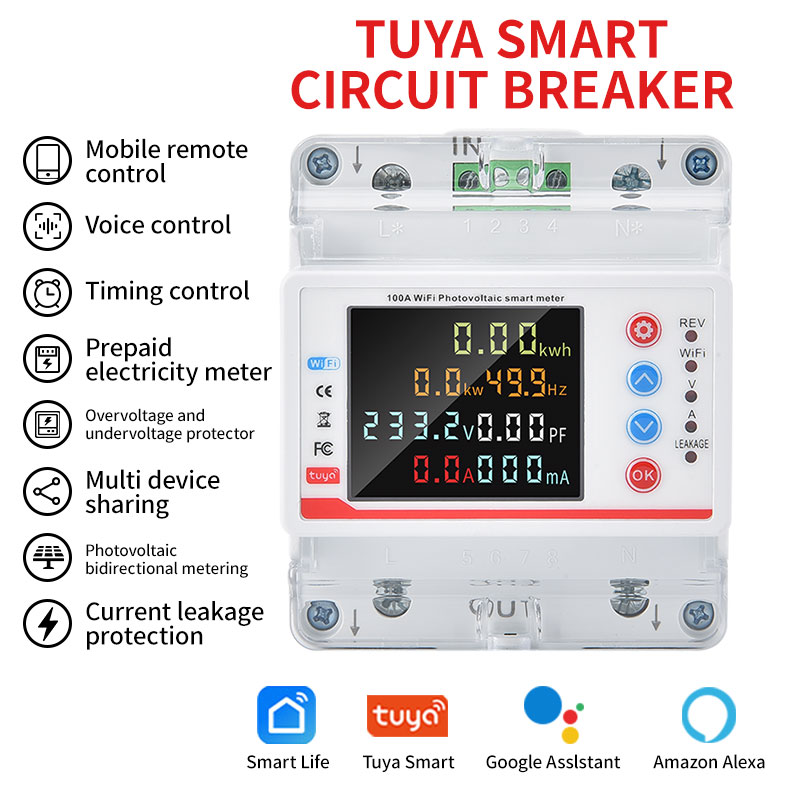
Evaluating offline data retention requires matching storage capacity with expected downtime. Standard residential meters often feature 3-day buffers. Industrial facilities require extended 30-day buffers to survive prolonged infrastructure failures. You must calculate the exact number of days a meter can hold data before overwriting older files. This calculation depends entirely on the logging frequency and the number of parameters being recorded.
For example, logging only active power (kWh) every 30 minutes consumes very little memory. However, logging voltage, current, active power, reactive power, and power factor across multiple phases every 5 minutes will fill a standard memory chip rapidly. Engineers must review the memory specifications (often listed in kilobytes or megabytes) and calculate the maximum offline duration based on their specific data payload size.
Logging both imported and exported energy during outages adds complexity. A bidirectional energy meter must utilize dual-register caching. This prevents missed export credits during grid-tied solar applications and ensures net-metering compliance. If the network drops while the solar array is exporting maximum power to the grid, the meter must accurately cache that exported volume. Failure to do so results in direct financial loss for the system owner.
Managing the exponentially higher data volumes generated by a three phase photovoltaic smart meter requires robust memory. These devices track multiple parameters per phase. This high-density data can quickly overflow standard local memory buffers. When specifying meters for commercial solar installations, the memory capacity must be scaled up to handle the increased data density.
Upon WiFi reconnection, the meter initiates a data dump. Handling this surge requires efficient protocols. MQTT, CoAP, or lightweight HTTP protocols ensure ordered packet delivery. They prevent network flooding and guarantee data integrity during the sync phase. MQTT, in particular, uses Quality of Service (QoS) levels to guarantee message delivery. A QoS level of 1 or 2 ensures that the cached data is received and acknowledged by the server before the meter deletes it from its local memory.
Logging Frequency | Data Points Per Day | Estimated Buffer Capacity (Standard Memory) | Best Use Case |
|---|---|---|---|
1 Minute | 1,440 | 24 to 48 Hours | Micro-grid balancing, critical load monitoring |
5 Minutes | 288 | 7 to 10 Days | Industrial process monitoring, demand response |
15 Minutes | 96 | 14 to 30 Days | Commercial submetering, standard utility billing |
60 Minutes | 24 | 60+ Days | Long-term residential trending, remote locations |
Granular data collection introduces a distinct trade-off. Logging data at 1-minute intervals provides excellent visibility but increases the risk of memory overwrite during extended network outages. First-In, First-Out (FIFO) protocols will erase the oldest data once the buffer fills. You must balance the need for high-resolution telemetry against the physical limits of the onboard storage.
If a facility requires 1-minute interval data for precise load balancing, the engineering team must accept that a network outage lasting longer than 48 hours will result in the loss of the oldest interval data. To counter this, they might implement redundant network paths, such as a cellular backup router, to ensure the outage never reaches the 48-hour threshold.
Meters with large onboard memory carry a higher upfront capital expenditure. However, they provide edge-autonomous resilience. Cheaper, low-memory meters reduce initial hardware costs but demand highly stable, redundant network infrastructure. This shifts the financial burden to higher operational expenditures for network maintenance and IT support.
Investing in edge-autonomous meters acts as an insurance policy against network instability. The slightly higher unit cost pays for itself the first time a major ISP outage occurs during a critical billing cycle. Facilities located in areas with poor telecommunications infrastructure must prioritize edge storage over cloud dependency.
Internal Real-Time Clock (RTC) drift can corrupt the timestamps of cached interval data. When timestamps drift, utility billing becomes misaligned, and load profile analysis fails. Crystal oscillators used in RTCs are sensitive to temperature fluctuations. Over a multi-day offline period, the internal clock might drift by several seconds or even minutes.
To mitigate this, specify meters with temperature-compensated, battery-backed RTCs. Ensure the system forces a Network Time Protocol (NTP) sync immediately upon network reconnection to correct any minor deviations. The synchronization process should adjust the timestamps of the cached data retroactively if a significant drift is detected, ensuring the load profile aligns perfectly with the utility's master clock.
Reaching maximum storage capacity during prolonged WiFi outages causes the oldest data to be overwritten. This First-In, First-Out mechanism ensures the meter never stops recording, but it sacrifices historical logs. If a 14-day outage occurs on a meter with a 7-day buffer, the first 7 days of interval data are permanently lost.
Size the meter's memory based on worst-case network downtime scenarios. Reduce logging frequency for non-critical telemetry metrics to extend the buffer lifespan. For example, you might configure the meter to log total kWh every 15 minutes, but only log voltage and power factor every 60 minutes. This selective logging strategy maximizes the retention period for the most critical billing data.
Network interruptions are inevitable in real-world deployments, but data loss is entirely preventable with the correct hardware architecture and edge-storage capabilities. Prioritize devices equipped with non-volatile memory, sufficient offline interval caching for at least 72 hours, and robust, automated post-outage synchronization protocols.
Audit your facility's network stability to determine the average length of connectivity drops.
Define the maximum acceptable offline duration for your specific energy management use case.
Specify exact memory capacities and RTC battery backup requirements in your upcoming procurement cycle.
Configure logging intervals to balance data granularity with local storage limits.
A: No. Modern meters use local non-volatile memory to store interval data and accumulative registers to track total consumption. Data is safely cached offline and transmitted once the network connection is restored.
A: Storage duration depends on the meter's memory capacity and the logging frequency. Standard meters typically store 15-minute interval data for 3 to 30 days before older data is overwritten by the FIFO buffer.
A: During a complete grid failure, the meter uses residual capacitor energy to execute a last gasp write sequence. It saves the current import and export register states to non-volatile memory before shutting down.
A: Upon reconnection, the meter automatically initiates a data dump. It uses lightweight protocols like MQTT to transmit the cached data bursts in chronological order, ensuring seamless reconciliation with the cloud server.
A: While not strictly required, a local gateway acts as a secondary storage buffer. It is highly recommended for three-phase systems because it efficiently manages the massive data volumes generated across multiple phases.
A: A last gasp signal is an automated process triggered by sudden power loss. The meter utilizes stored energy in its capacitors to quickly save active RAM data into permanent flash memory and send a final outage notification.
A: No. Total kWh is tracked via a mechanical or digital accumulative register. This absolute value continues to count accurately regardless of network status, ensuring total billing metrics remain perfectly intact.


