
Views: 0 Author: Site Editor Publish Time: 2026-09-01 Origin: Site


Electrical panels are shifting from passive safety enclosures to active data nodes within modern energy management systems. Facility managers and industrial engineers frequently face critical blind spots regarding device-level power quality and energy consumption. Traditional monitoring solutions require installing secondary, space-consuming energy meters inside already crowded distribution boards. These external monitors also lack integrated control capabilities for high-draw loads like electric vehicle chargers, commercial water heaters, and HVAC systems. Understanding the internal telemetry, sensor architecture, and data transmission protocols of a Smart Circuit Breaker is essential. This knowledge allows you to evaluate its measurement accuracy, network security, and viability for large-scale energy optimization and remote infrastructure management. We will examine exactly how these devices capture, process, and transmit real-time electrical data without compromising their primary thermal-magnetic protective functions.
Integrated Telemetry: Smart circuit breakers utilize embedded current transformers (CTs) and voltage sensors coupled with microprocessors to capture real-time power metrics without external metering hardware.
Two-Way Communication: Beyond passive monitoring, these devices function as a remote smart MCB (Miniature Circuit Breaker), allowing for programmatic load shedding and remote actuation based on the recorded data.
Ecosystem Dependency: The value of the recorded data relies heavily on the transmission protocol (e.g., Wi-Fi, Zigbee, Modbus) and the backend ecosystem, such as a Tuya WiFi smart MCB integration or custom MQTT brokers.
Safety, Health, and Analytics: Advanced models integrate the functionality of a smart leakage circuit breaker, recording fault data (like residual current) alongside standard energy consumption metrics and internal device health diagnostics to predict maintenance needs.
Recording electrical data begins directly on the load path inside the breaker housing. Miniaturized solid-state sensors and internal Current Transformers (CTs) measure amperage and voltage continuously. Engineers design these internal sensors to fit within standard DIN rail dimensions, completely replacing the need for bulky external clamp-on meters. For lower amperage models, manufacturers often use precision shunt resistors. As current passes through the shunt, it creates a tiny voltage drop proportional to the current flow. For higher amperage models, miniaturized Rogowski coils or standard magnetic CTs detect the magnetic field generated by the current. They convert this field into a proportional low-voltage analog signal.
The internal Analog-to-Digital Converter (ADC) dictates the quality of the recorded data. High-frequency sampling captures transient spikes, harmonic distortion, and power quality anomalies. Standard interval logging only records average consumption over a set period. High-frequency ADCs sample the electrical sine wave thousands of times per second—often at 4kHz to 8kHz. This rapid sampling identifies micro-fluctuations in voltage, helping technicians diagnose motor winding degradation or grid instability. Bidirectional measurement capabilities allow the sensors to differentiate current direction. They distinguish between incoming grid energy and outgoing power from distributed energy resources. You need this specific feature for sites utilizing solar inverters or battery energy storage systems.
Raw electrical waveforms generate massive amounts of data. Sending this raw data directly to a local network or cloud server would cause immediate bandwidth overload. An internal microprocessor solves this problem through edge computing. The microcontroller sits on the breaker's internal printed circuit board, receiving the digitized signals from the ADC.
The processor calculates Root Mean Square (RMS) voltage, RMS current, active power (kW), reactive power (kVAR), apparent power (kVA), power factor, and total energy consumption (kWh) locally. It performs these complex mathematical integrations in real time. Edge computing prevents network congestion by sending small, aggregated data packets at set intervals. The breaker transmits a clean digital payload rather than a continuous analog waveform. This local processing ensures data accuracy even if the external network connection drops momentarily.
Advanced protective devices do more than measure standard power flow. A smart leakage circuit breaker records specific fault conditions. It distinguishes between normal operational loads and dangerous ground faults. The internal sensors utilize a zero-sequence current transformer to monitor the balance between the active phase and neutral conductors. Any imbalance indicates residual current leaking to the ground.
The microprocessor logs exact trip events. It stores the specific electrical parameters present at the exact millisecond of a trip. Technicians use this stored current and voltage spike data for post-incident forensic analysis. It eliminates guesswork when troubleshooting nuisance tripping on complex circuits. These devices also feature self-monitoring capabilities. Internal thermistors track the breaker's own health metrics by monitoring operating temperatures across the mechanical contacts. High temperatures indicate loose terminal connections or severe contact wear. The system flags these anomalies to predict maintenance needs before a physical failure or electrical fire occurs.
Data holds no value if it remains trapped inside the electrical panel. Transmission protocols dictate how the breaker communicates with external energy management systems. You must evaluate the trade-offs between wireless and wired topologies based on the installation environment. Wi-Fi offers high bandwidth and easy integration with existing IT infrastructure. Zigbee and LoRaWAN provide excellent range and lower power consumption, creating self-healing mesh networks across large commercial facilities.
Hardwired RS-485 utilizing the Modbus RTU protocol remains the standard for heavy industrial environments. Wired connections eliminate signal interference issues common in dense electrical panels. Metal enclosures often act as Faraday cages, blocking wireless signals entirely. Wired topologies guarantee data delivery but require extensive secondary control wiring during installation. Installers must route shielded twisted-pair cables through the panel gutters and daisy-chain the communication lines from breaker to breaker, terminating the end of the line with a 120-ohm resistor.
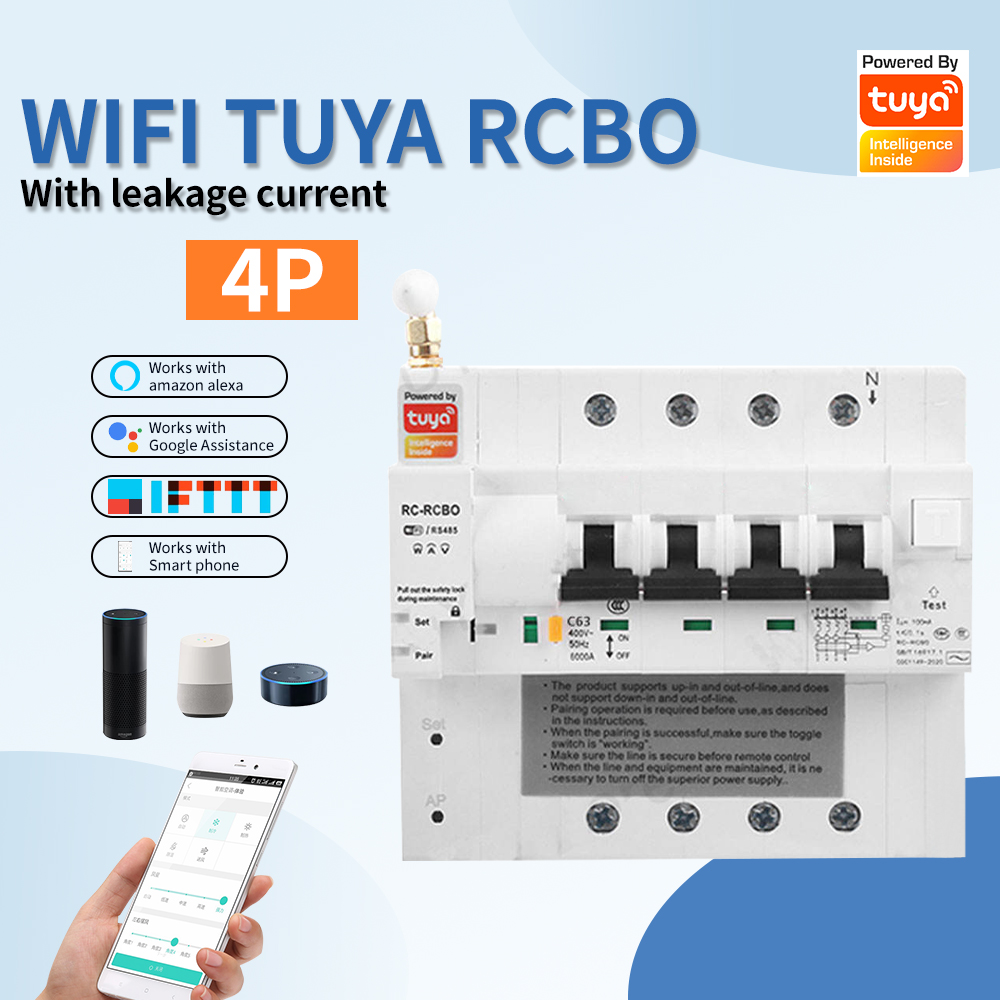
Consumer and light-commercial markets rely heavily on cloud-based architectures. Analyzing a Tuya WiFi smart MCB demonstrates this data flow clearly. The breaker captures the electrical metrics locally and formats them into a JSON payload. It transmits this payload via the local 2.4GHz Wi-Fi router to the Tuya cloud servers. The cloud platform aggregates the data, stores the historical logs, and pushes real-time updates to the end-user smartphone app or web dashboard.
Smartphone syncing enables immediate energy optimization. Real-time cloud data translates into user-facing insights. Facility managers can easily identify vampire loads and power-hungry appliances operating during peak rate hours. Relying on third-party cloud servers introduces specific operational realities. Cloud systems offer rapid deployment and polished user interfaces without requiring local server hardware. However, they introduce latency during remote actuation commands. Uptime depends entirely on the third-party server status and the facility's internet connection. API limitations may also restrict how frequently you can pull historical data for custom reporting.
Enterprise environments often prohibit sending critical infrastructure data to external cloud servers due to strict cybersecurity policies. Advanced integrations require local network access. Platforms like Home Assistant, Ignition, or industrial SCADA systems demand local MQTT brokers or REST APIs. This architecture keeps all electrical telemetry on-premises.
The breaker connects to the local isolated VLAN via Wi-Fi or Ethernet gateway.
The device publishes data payloads to a local MQTT broker on specific topics (e.g., panel_1/breaker_4/active_power).
The local energy management software subscribes to these topics, ingesting the data instantly.
The software evaluates the data against pre-programmed logic rules.
If a threshold is breached, the software publishes a command payload back to the breaker to open its contacts.
Local APIs allow developers to pull data directly from the breaker's IP address. It ensures millisecond response times for automated load shedding. Local control guarantees the energy management system functions perfectly even during total external internet outages.
Traditional energy monitoring relies on panel-level data. Technicians install large clamp-on CTs on the main incoming utility feeds. This measures the total grid income but provides zero visibility into individual branch circuits. Device-level monitoring isolates specific circuits. A smart circuit breaker provides exact consumption data for a single piece of equipment, allowing for precise energy auditing.
Space efficiency drives the adoption of integrated breakers. Crowded distribution boards lack the physical wire gutter space for secondary monitoring hardware. External meters require separate DIN rail mounting space, dedicated voltage reference wires tapped from the breakers, and bulky CT cables routed through the panel. Integrated breakers eliminate all secondary hardware. They occupy the exact same physical footprint as a standard breaker while delivering complete telemetry.
Installation Feature | Traditional Breaker + External Monitor | Integrated Smart Circuit Breaker |
|---|---|---|
DIN Rail Space Required | High (Requires 4 to 8 extra modules for the meter) | Low (Standard breaker footprint only) |
Wiring Complexity | High (CT routing, voltage taps, communication lines) | Low (Standard line and load terminations) |
Data Granularity | Panel-level or limited branch-level | Exact device-level telemetry |
Remote Actuation | Requires wiring a separate mechanical contactor | Built-in motorized mechanism |
Installation Labor Time | 45 to 90 minutes per monitored circuit | 5 to 10 minutes per circuit |
Monitoring alone cannot prevent peak demand charges. Actionable data requires automated physical responses. A remote smart MCB differs fundamentally from a standard energy monitor. It contains a miniaturized motorized gearbox attached to the switching mechanism. The energy management system reads the real-time data from the breaker.
If the telemetry indicates a peak demand-charge threshold is approaching, the system issues a command. The breaker automatically opens its contacts, cutting power to a non-critical load like an EV charger or water heater. Once the facility's total demand drops back to acceptable levels, the system commands the breaker to close. This automated load shedding happens without human intervention. External monitors require wiring a separate, space-consuming mechanical contactor to achieve this same functionality.
Financial modeling dictates hardware selection in large facilities. The upfront cost premium of smart breakers appears high when viewed individually. However, the calculation changes at scale. Compare the cost of 50 smart breakers against 50 traditional breakers, plus a 50-channel external energy monitor, plus 50 external contactors for control. The integrated approach significantly reduces total hardware costs. It also cuts installation labor hours by more than half. The reduction in wiring complexity lowers the risk of installation errors, loose terminations, and subsequent troubleshooting time.
Data accuracy determines the hardware's utility. Revenue-grade accuracy meets strict standards like ANSI C12.20 or IEC 62053-22 Class 0.5s. These devices offer 0.2% to 0.5% variance. Utilities require revenue-grade accuracy for financial tenant sub-billing. Standard operational accuracy typically falls between ±1% and 3%. This variance is perfectly acceptable for internal energy management, load shedding, and predictive maintenance.
Safety certifications remain non-negotiable. The addition of microprocessors and IoT radios must not compromise the breaker's primary protective function. You must verify UL 489, UL 1077, or IEC 60947-2 certifications. These marks ensure the thermal-magnetic trip unit operates entirely independently of the electronic monitoring components. The breaker must clear a short circuit mechanically even if the internal microprocessor fails entirely.
Pilot programs often succeed, but full deployments fail due to poor data handling. Assess how the software platform manages data from hundreds of breakers simultaneously. High-frequency data logging generates gigabytes of data monthly. Evaluate the platform's data retention policies. Some cloud systems overwrite historical data after 30 days to save server space.
Export capabilities are critical for custom analytics. The system must support CSV exports or API webhooks. Facility managers need historical trend analysis features to track seasonal energy variations. Ensure the backend time-series database can query long-term data without experiencing severe interface lag.
Networked electrical infrastructure presents a tangible cybersecurity target. You must evaluate the encryption standards for data in transit and data at rest. Transport Layer Security (TLS 1.2 or higher) is mandatory for all wireless payloads. Remote actuation features introduce operational vulnerabilities. Unauthorized access to the breaker's control API could allow malicious actors to shut down critical facility loads.
Implement strict role-based access controls (RBAC) for all dashboard users.
Enforce multi-factor authentication (MFA) for any account capable of issuing remote switching commands.
Isolate all smart breakers on a dedicated IoT VLAN separate from corporate data networks.
Disable unused communication ports and protocols on the local gateway.
Network connections drop. Facilities must plan for offline behavior. When the Wi-Fi or local network goes down, the breaker loses its transmission path. High-quality devices utilize onboard Non-Volatile Random-Access Memory (NVRAM). This memory acts as a data buffer. It caches the energy metrics locally during the outage. Once the network restores, the breaker backfills the missing data to the server. This prevents gaps in the historical energy logs.
Basic safety mechanisms remain entirely unaffected by network status. The bimetallic strip for overload protection and the magnetic coil for short-circuit protection are physical components. They trip the breaker mechanically. Network latency only affects the remote reporting and remote actuation features.
Upgrading legacy electrical panels introduces physical constraints. Smart breakers often have a slightly larger footprint than standard miniature circuit breakers. They may require deeper panel enclosures to accommodate the internal electronics and motorized actuators. Verify compatibility with existing busbars. Standard DIN rail mounting offers universal compatibility. Proprietary plug-on neutral panels restrict hardware choices to specific manufacturers.
Signal interference poses a major retrofitting challenge. Metal electrical enclosures create a Faraday cage effect. This severely degrades Wi-Fi and Zigbee signal strength. Installers must overcome this by using breakers with external antenna leads. You route the antenna through a standard knockout using an IP68 cable gland and mount it outside the metal panel. Alternatively, replacing the metal panel door with a heavy-duty polymer cover allows radio frequencies to pass through unimpeded.
IoT devices require regular software maintenance. Over-The-Air (OTA) firmware updates patch security vulnerabilities and improve measurement algorithms. However, OTA updates carry operational risks. A power fluctuation during an update can corrupt the flash memory, bricking the electronic components. While the mechanical safety trip will still function, the device loses all monitoring and remote control capabilities. Look for devices with dual-bank memory that can automatically roll back to a previous firmware version if an update fails.
Vendor lock-in represents a long-term reliability risk. Proprietary cloud ecosystems force users to rely on the manufacturer's servers. If the manufacturer discontinues the product line or shuts down the server, the smart features cease to function. Prioritize hardware that supports open protocols like MQTT or Modbus to ensure decades of usable lifespan independent of the original manufacturer.
Conduct a comprehensive panel audit to verify physical depth clearances, DIN rail space, and busbar compatibility before purchasing hardware.
Define your exact data retention requirements and API integration needs to choose between cloud-based platforms or local MQTT architectures.
Install external antennas or modify panel enclosures if utilizing wireless protocols in heavy industrial environments to prevent signal loss.
Initiate a localized pilot test using two or three breakers on non-critical loads to validate measurement accuracy against existing utility meters.
Establish strict cybersecurity protocols, including VLAN segregation and multi-factor authentication, before enabling any remote actuation features.
A: Most commercial smart breakers offer an accuracy variance of 1% to 3%. This accuracy is sufficient for energy management, load shedding, and predictive maintenance. However, they typically do not replace revenue-grade utility meters for official financial billing purposes.
A: No. The primary safety mechanisms operate entirely at the hardware level. The thermal-magnetic or electronic trip units function instantly during a fault, regardless of network connectivity, Wi-Fi status, or software glitches.
A: Data is transmitted in real-time to the Tuya cloud infrastructure. The cloud server aggregates and stores the metrics. Historical data access depends on the specific manufacturer's cloud retention policy, which usually ranges from 30 days to one full year.
A: It cannot identify the specific appliance causing the issue. However, it records the exact electrical signature at the time of the trip. Technicians use this residual current and voltage drop data to diagnose whether the fault was a ground leak, arc fault, or standard overload.
A: Yes. Many advanced smart breakers feature bidirectional metering. This allows the internal sensors to record both the energy drawn from the utility grid and the energy fed back into the system from local solar panels or battery storage.
A: High-quality smart breakers feature onboard NVRAM. This memory caches the energy data locally during a network outage. Once the Wi-Fi connection is restored, the breaker syncs the cached data to the cloud or local server to prevent data gaps.
A: Yes, provided you select the correct hardware. Choose a breaker that supports open protocols like Modbus RTU/TCP, MQTT, or offers a documented REST API. Closed-ecosystem breakers may require complex third-party workarounds for BMS integration.


