
Views: 0 Author: Site Editor Publish Time: 2026-11-10 Origin: Site


Picture this scenario. A severe summer storm rolls into your neighborhood. It takes down power lines and severs your Internet Service Provider connection. Suddenly, your home loses its digital link to the outside world. Smart speakers stop responding. Automated devices show a frustrating offline status in your mobile application. Facing this digital blackout, a critical question arises regarding the most vital components of your electrical panel.
Homeowners, facility managers, and electricians frequently ask if upgrading to intelligent electrical infrastructure means sacrificing basic safety. It is a completely valid concern. Relying on remote cloud servers for critical home safety feels inherently risky.
The definitive answer is highly reassuring. These modern electrical safeguards absolutely run without the internet. While you temporarily lose cloud-based remote control and real-time data logging, the fundamental hardware safety mechanisms remain entirely intact. Tripping during an electrical overload and manual switching operations never falter.
This comprehensive guide explores exactly what happens to your intelligent electrical panel when the network drops. We will examine the critical differences between local and cloud control, analyze current industry shifts toward edge computing, and explain why these devices feature mechanical fail-safes to protect your property under any conditions.
Safety is Hardware-Based: Intelligent breakers rely on physical, internal mechanisms to protect against short circuits and overloads. This core protective function never requires an internet connection.
Manual Control Remains: You can always manually toggle the physical switch on your device, even if your router is completely destroyed or unplugged.
Cloud vs. Local: While remote app control from outside the home breaks without the internet, some ecosystems allow for Local Area Network control if your local router is still powered on.
Ecosystem Reliability: Premium hardware is designed to reconnect automatically and sync stored data once the internet is restored, ensuring no long-term disruption to your home automations.
Future-Proofing: Upgrading your panel enhances electrical safety and energy tracking without compromising the proven reliability of traditional Miniature Circuit Breakers.
To fully grasp offline functionality, we must look at traditional electrical safety architecture. A standard Miniature Circuit Breaker serves a singular purpose. It protects an electrical circuit from damage caused by excess current. It accomplishes this using two primary physical mechanisms. A bimetallic strip bends and trips the breaker during a prolonged thermal overload. Meanwhile, a magnetic coil reacts instantly to the massive current surge of a short circuit.
Modern electrical engineering takes this proven mechanical foundation and integrates an IoT module. Consequently, the device possesses the exact same physical safety hardware as a traditional breaker. It simply adds a sophisticated digital layer for communication and monitoring. The microprocessor does not replace the safety components; it operates alongside them.
When connected to a stable network, a smart circuit breaker offers advanced capabilities that passive models cannot match. Users gain the ability to perform remote switching via smartphone applications. Building on this connectivity, these units provide real-time energy monitoring. This precise power consumption tracking empowers facility managers to identify appliances drawing excessive standby power.
Furthermore, custom scheduling enables automated routines. You can automatically power down high-drain appliances during peak utility rate hours to optimize electricity expenditure. These units typically feature a rated operational voltage of 230V or 400V and maintain a robust breaking capacity, ensuring they handle standard residential and commercial loads effortlessly.
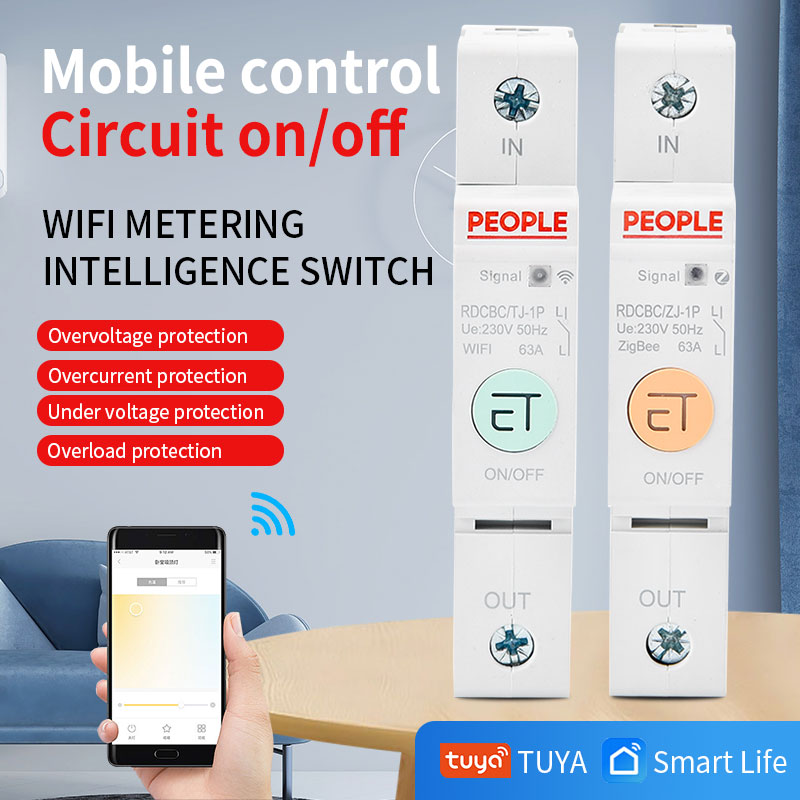
When your ISP experiences a localized outage, your home network loses its connection to external cloud servers. However, your intelligent electrical infrastructure does not transform into a useless brick. Understanding the division between offline capabilities and cloud-dependent features sets realistic expectations.
The most crucial aspect of your electrical panel is its offline reliability. Empirical testing and strict IEC safety standards dictate that human safety cannot rely on software. Overload and short circuit protection remain purely physical. Inside the unit, the bimetallic strip bends when heated by an overload, triggering a mechanical trip. These physical actions happen instantaneously. If a wire shorts out while your internet is down, the unit trips exactly as intended.
In addition, manual switching remains fully operational. Imagine standing in front of your breaker box with a flashlight during a blackout. Every unit retains a physical toggle switch. You can physically push the lever up or down to restore or cut power.
While mechanical safety stands firm, specific convenience features temporarily pause. Remote app control from outside the property will fail. The digital command path from your phone to the external cloud server is severed. Real-time push notifications will not trigger. Live energy data logging stops updating on your screen.
However, premium devices cache this data locally on internal flash memory. They automatically upload the backlog once the connection restores, ensuring no gaps in your energy consumption history.
Looking at the broader smart grid landscape, a significant shift is occurring in how we manage electrical infrastructure. Industry analysts note that homeowners and commercial facility managers are increasingly rejecting pure cloud-dependent architectures. The market is aggressively moving toward edge computing and hybrid local control.
In practical terms, this means processing power is shifting directly into the physical residence. By handling data locally on a hub rather than a distant server, automation rules execute entirely within your home. This makes modern properties vastly less reliant on external internet service providers and significantly reduces latency during critical electrical faults. Grid modernization now demands localized safety protocols that function seamlessly regardless of external bandwidth.
To understand offline limitations, one must map the standard communication pathway. Under normal operating conditions, a signal travels from your phone to a remote server, routes down to your router, and finally reaches the electrical panel. If your ISP link breaks, this chain collapses.
In contrast, a dropped internet connection does not necessarily mean your local WiFi network is dead. If the external internet is down but your router remains powered, your Local Area Network remains active. Specific device ecosystems support LAN control natively. If your smartphone connects to the same router as your panel, the app sends commands directly to the hardware. This bypasses the need to ping an external server, providing a robust layer of redundancy.
When introducing digital components to critical infrastructure, skepticism is natural. A common fear involves cyber attacks forcing a panel to stay on during a power surge. The objective answer is no. The thermal-magnetic trip mechanism physically overrides the digital relay. Even if a malicious software glitch attempts to force the switch into the ON position, the bimetallic strip still bends under excess heat. Digital commands cannot bypass the laws of physics.
In terms of preventative safety, upgrading your standard panel to a WiFi smart circuit breaker holds a distinct advantage. Let us look at a direct comparison.
Feature | Traditional MCB | Smart WiFi Circuit Breaker |
|---|---|---|
Overload Protection | Mechanical Bimetallic | Mechanical Bimetallic |
Short Circuit Protection | Magnetic Coil | Magnetic Coil |
Internet Required for Safety | No | No |
Preventative Monitoring | None | Real-time current & voltage tracking |
Remote Operation | None | App & Voice Control |
This advanced hardware allows you to monitor abnormal power draws long before a physical trip becomes necessary. If an aging HVAC compressor draws 20 percent more current than usual, the energy monitoring dashboard reflects this anomaly. This alerts you to a failing motor before it causes an electrical fire.
The smart home market is highly fragmented. Yet, the Tuya ecosystem has emerged as a dominant industry standard due to its robust architecture. Tuya provides the underlying software for millions of devices globally, utilizing highly stable connection retention.
One critical feature of premium hardware is the Relay Status memory function. Users configure exactly how the hardware behaves following a grid failure. You can program the unit to remain Always OFF when power returns to protect sensitive equipment from voltage spikes. Alternatively, set it to Always ON for critical systems like refrigerators.
Selecting the appropriate hardware configuration depends entirely on your specific electrical architecture. For standard residential lighting and general outlet circuits, a 1P+N configuration rated at 63A provides excellent monitoring. It handles standard 230V loads seamlessly while tracking leakage currents.
Conversely, for heavy-duty appliances like central air conditioning systems or Level 2 EV chargers, you need a different approach. Integrating a robust Tuya smart WiFi circuit breaker designed for 2P 63A applications ensures both hot lines are actively monitored. These 2P units typically support precise overvoltage and undervoltage protection thresholds, providing maximum safety for demanding household loads.
The most effective method for maintaining local control is plugging your router and automation hubs into an Uninterruptible Power Supply. A UPS acts as a large battery backup. If your ISP goes down but the neighborhood grid remains powered, the UPS ensures your LAN remains active.
While WiFi is highly accessible, advanced automation enthusiasts often utilize alternative communication methods. Zigbee-enabled hardware creates a local mesh network. This protocol is inherently less reliant on traditional WiFi bandwidth, offering enhanced offline reliability for complex automation routines.
After analyzing the offline capabilities and mechanical safety features, the decision comes down to practical benefits versus temporary limitations. The benefits are substantial. Homeowners gain unprecedented visibility into their energy consumption. This allows for targeted efficiency improvements that lower utility bills. The convenience of remote switching and preventative maintenance adds layers of utility that traditional breakers lack.
The primary limitation is the temporary loss of remote features during an ISP outage. However, this digital disconnection never impacts core mechanical safety. The temporary loss of smart features does not compromise the breaker features. When offline, these units operate as flawless traditional breakers. When online, they transform into powerful energy management tools.
Can modern, internet-connected electrical infrastructure run without the internet? Absolutely. It functions perfectly as a traditional, highly safe circuit breaker regardless of your network status. The core safety of your home's electrical panel is never compromised by dropped signals, severed fiber optic cables, or cloud server outages.
Take the next step in modernizing your property. Upgrade your home's electrical safety and intelligence today. For reliable, high-quality options tailored to your specific 1P+N or 2P circuit needs, explore the professional-grade solutions at People Elect (www.peopleelect.com). Ensuring your home remains both incredibly smart and fundamentally safe starts with choosing the right hardware.
No. The tripping mechanism for overcurrent and short circuits is purely mechanical and thermal. It relies on physical components that react to heat and magnetic forces. It protects your home perfectly even if the WiFi is completely disconnected.
Yes. Every unit features a physical switch or lever on the front panel. You manually toggle the power on or off directly at the breaker box, operating it exactly like a traditional unit.
In most cases, no. High-quality hardware contains onboard local memory. The devices continue recording your energy usage while offline. They automatically sync the cached data to your mobile app once the WiFi connection is successfully re-established.
It depends heavily on the specific brand and your network setup. Many modern devices support LAN control protocols. If your external internet is down but your router still broadcasts a signal, you can often control the hardware using your phone over the local network.
Advanced models allow you to configure their restart state directly in the application settings. You can program them to remain OFF, turn ON automatically, or remember their last state prior to the power loss.
Premium smart breakers feature auto-reconnection algorithms. Once your router reboots and broadcasts a stable 2.4GHz WiFi signal, the breaker automatically authenticates and reconnects to the network. No manual pairing is required unless your router credentials have changed.
No. The internal IoT communication module is highly energy-efficient. A typical smart breaker consumes less than 1 to 2 watts of standby power to maintain its WiFi connection and power its internal microprocessor, making its impact on your overall electricity bill negligible.


